

Instructor Responsibilities
The CFI is responsible for far more than transferring information. The certificate authorizes solo and certificate-recommendation endorsements — every signature carries regulatory weight and personal accountability. Below is what comes with that.
The Core Responsibility
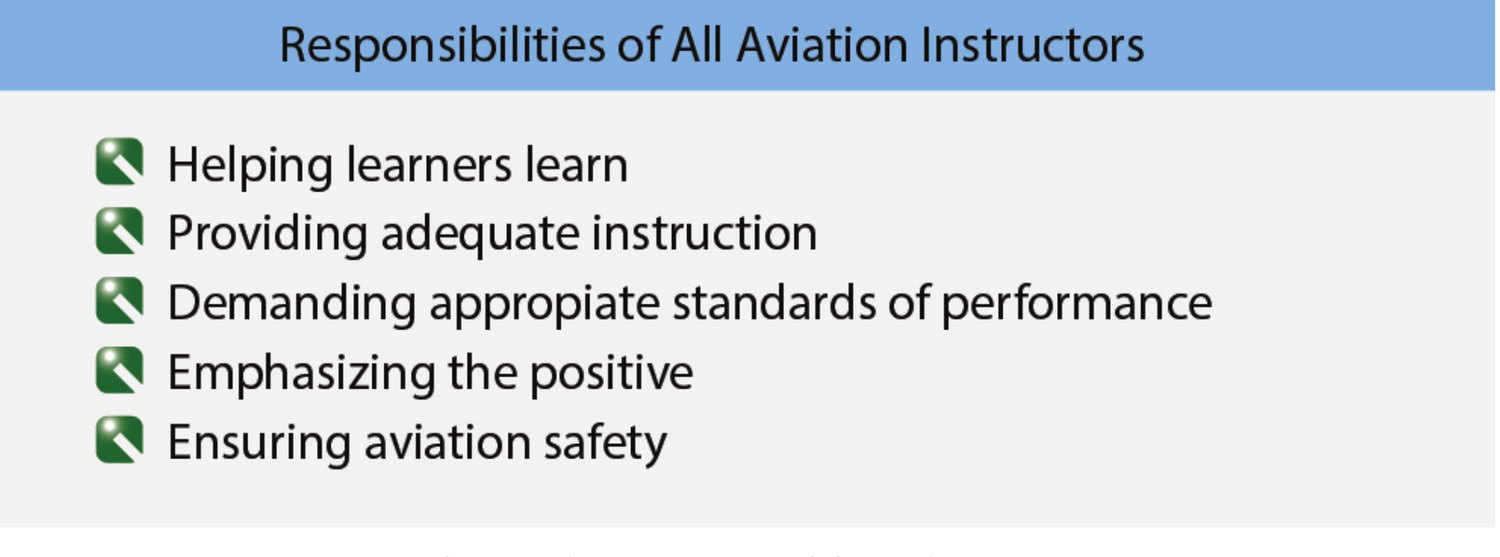
The flight instructor's central job is to produce safe, competent, well-judged pilots. Not to fill logbook hours. Not to push students toward solo or checkride before they're ready. Not to maximize the school's revenue.
Two principles to internalize:
- "A learner's failure to perform often results from an instructor's inability to transfer the required information." Before blaming the student, look at your own teaching.
- "Emphasize the positive because positive instruction results in positive learning." Negative instruction (yelling, shaming, sarcasm) creates fear; fear shuts down learning.
The Aviator Code of Conduct
- General responsibilities of aviators — uphold safety, professionalism, and the reputation of general aviation
- Passengers and people on the surface — operate without undue hazard to others
- Training and proficiency — maintain and demonstrate currency; recommend training when needed
- Security — comply with TSA guidance; report suspicious activity
- Environmental issues — minimize noise, fuel waste, and ground impact
- Use of technology — leverage avionics and tools without becoming dependent on them
- Advancement and promotion of GA — be an ambassador to the public
Professionalism — Six Characteristics
- Sincerity — be genuine. Students see through performance.
- Acceptance of the student — meet them where they are. Their goals, background, and pace.
- Proper language — clean, clear, and free of jargon the student hasn't learned
- Appropriate appearance — dress matters more than ego likes to admit. Look like a professional pilot.
- Demeanor — calm, focused, supportive. Not anxious, distracted, or hostile.
- Safety — model the safety culture you want students to adopt
Dealing with Student Stress and Anxiety
Stress is normal in flight training. Pathological stress is not — recognize it and respond.
- Watch for signs: tunnel vision, fixation, rapid breathing, perspiration, hesitation, errors that don't match the student's earlier proficiency
- If the student is no longer learning, stop the lesson. A bad lesson is worse than no lesson — primacy applies, and a stressful failure is the experience the student carries forward.
- Set a reasonable pace. Don't push through emotional limits.
- Build in successes. End lessons on a positive note when possible.
- Address the underlying issue — financial stress, schedule pressure, family — outside the cockpit. Acknowledge it; you don't have to solve it.
Student Pilot Supervision
- The CFI is responsible for the student's pre-solo training and for endorsing them when ready
- Solo endorsements are aircraft-make/model specific. Each authorization to solo a different aircraft requires its own endorsement.
- Cross-country solo flights require a separate endorsement specifying the route, including each leg, after the CFI has reviewed the planning
- The CFI's responsibility extends to every solo flight a student makes under the CFI's endorsement — verify currency, weather, and aircraft squawks before signing
The Flight Review (FAR § 61.56)
Every certificated pilot must complete a flight review within the preceding 24 calendar months to act as PIC. The CFI conducting it is responsible for:
Calendar months, not rolling ones — a review on 3 March 2026 is good through 31 March 2028, not to 3 March. The ways out of needing one at all are listed under Special cases below.
- Evaluation of piloting ability — to standards appropriate to the certificate held
- Pilot supervision — for the duration of the review
- Minimum content: 1 hour ground (operating rules, ADM) + 1 hour flight (maneuvers appropriate to the certificate)
- Not a checkride — the standards are safe, not "ACS perfect"
- Endorsement language is specified in AC 61-65K. If the pilot doesn't meet the standard, the CFI does not endorse — but recommends additional training instead
Special cases:
- Holders of new certificates within the preceding 24 months are exempt
- WINGS program — completion of one phase satisfies the flight review requirement
- SFAR 73 (R-22 / R-44) — the review must be in the same model and includes specific topics (autorotation, low-G, low rotor RPM, governor-off RPM control)
Practical Test Recommendations
The CFI signs the recommendation that authorizes a student to take their practical test. The signature is a regulatory statement: "This applicant has received the required training and is prepared for the practical test."
- The CFI must have personally observed satisfactory performance of every task in the relevant ACS
- The recommendation is given only when the CFI is genuinely confident — not because the student wants to schedule the test
- An over-eager recommendation that produces a checkride bust hurts the student more than the delay would have
- Track record matters — instructors with a high pass rate get an easier ride from FSDOs and DPEs
Additional Training and Endorsements
The CFI is responsible for additional training and endorsements throughout a pilot's career:
- Complex aircraft — high-performance, tailwheel, pressurized (one-time endorsement per category)
- BFR / WINGS — recurrent training
- IPC (Instrument Proficiency Check) — required after 6 months of instrument inactivity
- Type-specific training — model-specific operations beyond the basic certificate (R-22 SFAR 73, etc.)
- Refresher training — pilots returning after a long break
See the Endorsements page for the regulatory citations and template language.
Professional Development
The CFI is responsible for maintaining their own knowledge and skills.
- Re-read the handbooks (FAA-H-8083-9B, 8083-21, 8083-25) periodically — they update
- Stay current on FAR changes and FAA guidance (AC updates, InFO bulletins, SAFO bulletins)
- Attend recurrent training: FIRC (Flight Instructor Refresher Course), simulator-based recurrent, type-specific training
- Read accident reports — every NTSB rotorcraft accident is a teaching case
- Get regular flight time as the student, not just as the instructor. It's easy for an instructor to slip into bad habits when no one is watching.
Recent experience — every 24 calendar months
This used to be called renewal, and it no longer is. A flight instructor certificate issued on or after 1 December 2024 has no expiration date (§ 61.19(d)(1)); one issued before that date expires 24 calendar months from the month of issue, renewal, or reinstatement (§ 61.19(d)(2)). What lapses now is the privilege to instruct, not the certificate.
Under § 61.197 you may exercise instructor privileges only if you satisfied one of these within the preceding 24 calendar months:
- Pass a practical test for one of the ratings on your instructor certificate, or for an additional instructor rating
- FIRC (Flight Instructor Refresher Course) — completed within the preceding 3 calendar months
- Endorse at least 5 applicants for a practical test in the preceding 24 calendar months, with at least 80% passing on the first attempt
- Serve as a company check pilot, chief flight instructor, company check airman, or as an instructor in a part 121 or 135 operation, or in a position regularly evaluating pilots
- Pass a U.S. Armed Forces instructor pilot or examiner proficiency check
- Instruct in an FAA-sponsored pilot proficiency program meeting § 61.197(b)(2)(v)
The 24-month window runs from the month the certificate was issued, the month you accomplished the recent-experience requirement, or the last month of your current period if you meet the requirement within the 3 calendar months before it (§ 61.197(a)).
If it lapses you may not exercise instructor privileges until they are reinstated under § 61.199. Within 3 calendar months or less of the last month of your recent-experience period, a FIRC will do it. Past 3 calendar months, it takes a flight instructor practical test for a rating you hold or an additional one. Military instructor pilots and examiners have a separate 6-calendar-month route under § 61.199(a)(3).
The CFI's Regulatory Exposure
Every signature in a student's logbook is potentially a piece of evidence. The CFI is exposed to:
- FAA enforcement for inadequate training that contributes to an incident
- NTSB review following an accident involving a student
- Civil liability if a student causes property damage or injury
Mitigations:
- Document everything — lesson records, student-pilot endorsements, weather, aircraft squawks, decisions made before flight
- Don't endorse until you've personally observed the relevant skills
- Carry instructor liability insurance (separate from the school's coverage)
- If something goes wrong, cooperate with investigators but speak with an aviation attorney before making formal statements