

ADM, CRM & Risk Management
Commercial flying multiplies the pressure to fly when you shouldn't — paying customers, deadlines, weather windows, return trips. The ADM frameworks below exist because every one was bought with a fatal accident.
The Three Ps
The simplest decision-making loop. Use it continuously throughout a flight.
- Perceive the hazards (weather, fatigue, terrain, mechanical issues)
- Process the level of risk each hazard poses
- Perform risk management — mitigate, transfer, accept, or refuse the flight
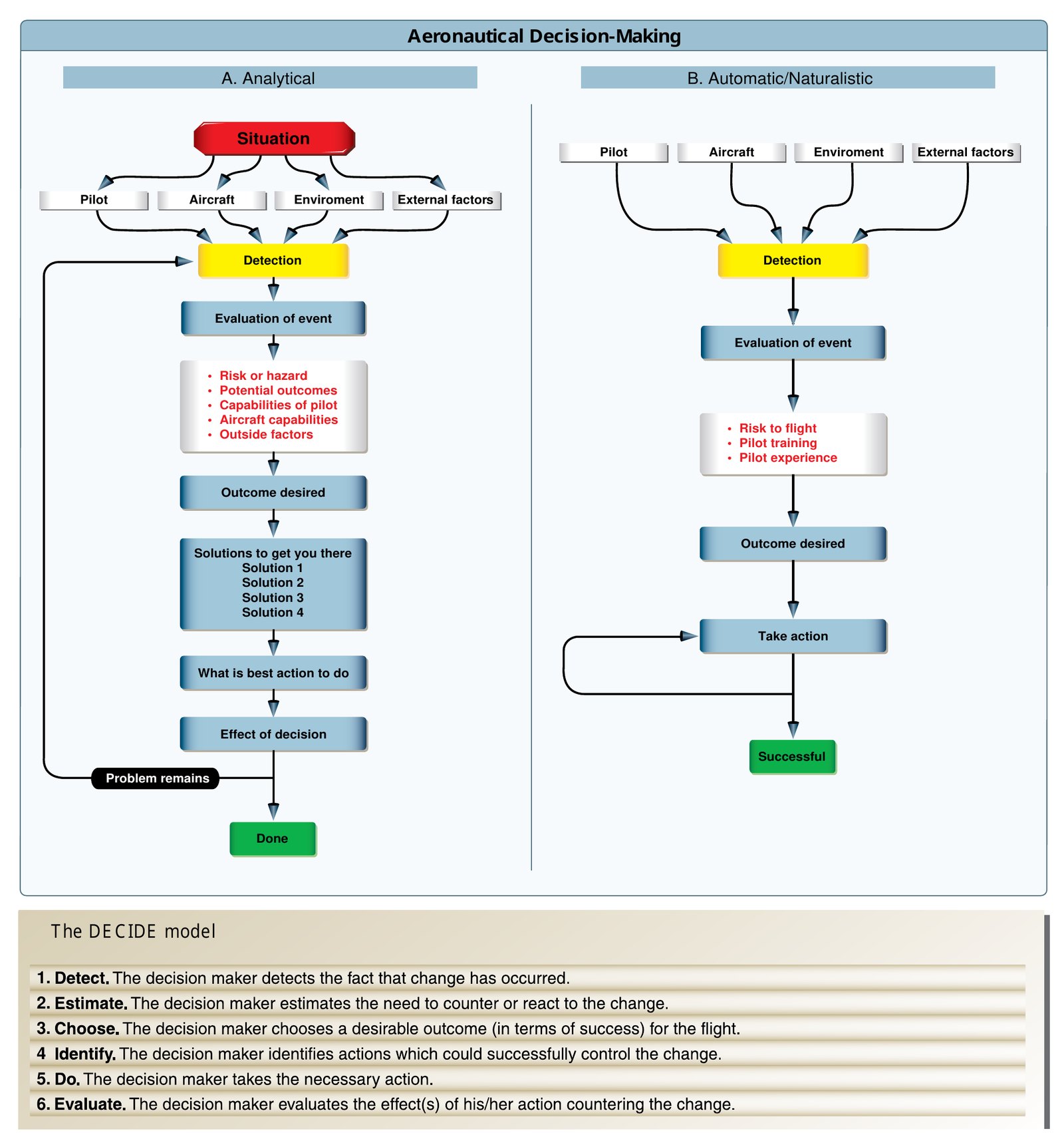
The DECIDE Model
A six-step process used in real time when you encounter a problem in flight.
- D — Detect a change has occurred
- E — Estimate the need to react to the change
- C — Choose a desirable outcome
- I — Identify actions that lead to the outcome
- D — Do the necessary actions
- E — Evaluate the effect of the action
The Five Ps
A pre-flight and in-flight checklist for the major risk categories. Run it at every decision point — pre-takeoff, pre-departure, top of climb, pre-descent, pre-landing.
- The Plan — Mission, route, weather, NOTAMs, alternates
- The Plane — Mechanical condition, fuel, weight & balance, performance
- The Pilot — Currency, experience for the conditions, fatigue, IMSAFE
- The Passenger — Briefing, fitness to fly, schedule pressure they may put on you
- Programming — GPS, autopilot, avionics setup; brief the next phase before you need it
FRAT — Flight Risk Assessment Tool
A structured numeric or checklist-based pre-flight risk assessment. Used industry-wide in EMS, utility, and corporate operations.
- Score each risk factor (pilot, aircraft, environment, mission) and sum the total
- Establish thresholds in advance: green (proceed), yellow (mitigate or get a second opinion), red (don't go)
- Setting the thresholds before the flight removes the temptation to rationalize after the schedule pressure builds
- If your operator doesn't have one, build one. There are FAA-published templates in AC 120-92D.
PAVE Checklist
The pre-flight risk inventory. A wider net than the Five Ps — used in flight planning before you start the engine.
- P — Pilot: Currency, experience, recency, fitness, fatigue (IMSAFE)
- A — Aircraft: Airworthiness, performance for the mission, fuel, equipment for the conditions
- V — enVironment: Weather (current and forecast), terrain, airspace, density altitude, daylight remaining
- E — External pressures: Schedule, customer expectations, get-home-itis, financial cost of cancelling
IMSAFE — Personal Fitness Checklist
Run before every flight. If you fail any one, you don't fly.
- I — Illness: Symptoms that affect performance, even minor ones — congestion alters middle ear pressure equalization
- M — Medication: Anything that has a "do not operate heavy machinery" warning, or anything new you haven't flown on before
- S — Stress: Personal, financial, or work — divides your attention
- A — Alcohol: 8 hours bottle-to-throttle minimum (FAR 91.17), 0.04% BAC limit, no remaining effects. The ethical standard is more conservative than the regulatory one.
- F — Fatigue: The most common factor in pilot performance degradation. Rest is part of preflight.
- E — Emotion: Anger, grief, distraction — emotional state affects judgment more than people admit
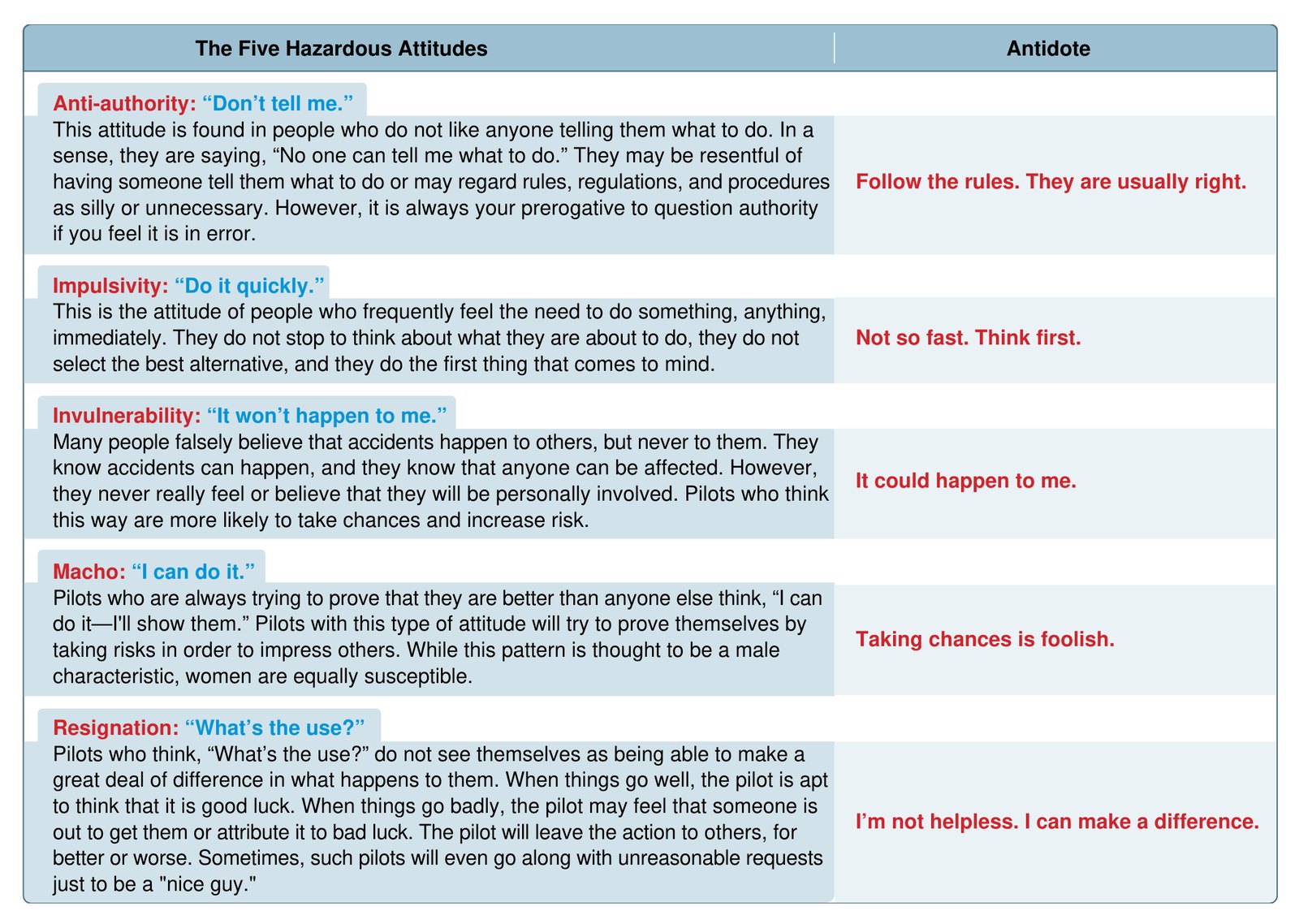
The Five Hazardous Attitudes (AIIMR)
Recognize each attitude in yourself, then apply the antidote. The antidote phrases are not memorization filler — they are the conscious self-talk that breaks the pattern.
- Anti-Authority — "Don't tell me!" — Antidote: Follow the rules. They are usually right.
- Impulsivity — "Do something — quickly!" — Antidote: Not so fast. Think first.
- Invulnerability — "It won't happen to me." — Antidote: It could happen to me.
- Macho — "I can do it." — Antidote: Taking chances is foolish.
- Resignation — "What's the use?" — Antidote: I'm not helpless. I can make a difference.
CRM in a Single-Pilot Helicopter
Helicopter operations are usually single-pilot. CRM still applies — it's about resource management, not crew size.
- External resources: ATC, FSS, dispatch, mechanics, weather services, your own briefer
- Onboard resources: Passengers (yes — passengers can spot traffic and read approach plates), checklists, GPS, radios
- Internal resources: Training, experience, the ability to recognize that you are saturated and need to slow down
- The single-pilot version of "speak up": say it out loud to yourself. Verbalize the next step, the abnormal you spotted, the decision you just made. It catches errors you would otherwise miss.
Operational Pitfalls
Behavior patterns that the FAA has identified as recurring contributors to accidents:
- Peer pressure — Flying because someone else expects you to
- Mind set — Inability to recognize and respond to changing conditions
- Get-there-itis — Fixation on the destination at the expense of safe alternatives
- Duck-under syndrome — Sneaking under low cloud or terrain to keep the destination in sight
- Scud running — Trying to maintain visual contact with terrain in marginal weather
- Continuing VFR into IMC — Leading cause of fatal GA weather accidents
- Getting behind the aircraft — Reactive rather than anticipatory
- Neglect of flight planning, preflight, checklists — Complacency from prior success
- Loss of positional awareness — Not knowing where you are over terrain or in airspace
- Operating without adequate fuel reserves — Including reserves consumed by unexpected delays
- Descent below MEA / minimums — Without IFR clearance and equipment
- Flying outside the envelope — Beyond aircraft or pilot limitations
- Neglect of NOTAMs — TFRs, runway closures, equipment outages