

Mountain & Hilly Terrain Operations
Mountain flying combines high density altitude, unpredictable winds, marginal performance, and visual illusions. Many of the techniques are the opposite of what feels natural — that's why mountain flying kills experienced flatland pilots.
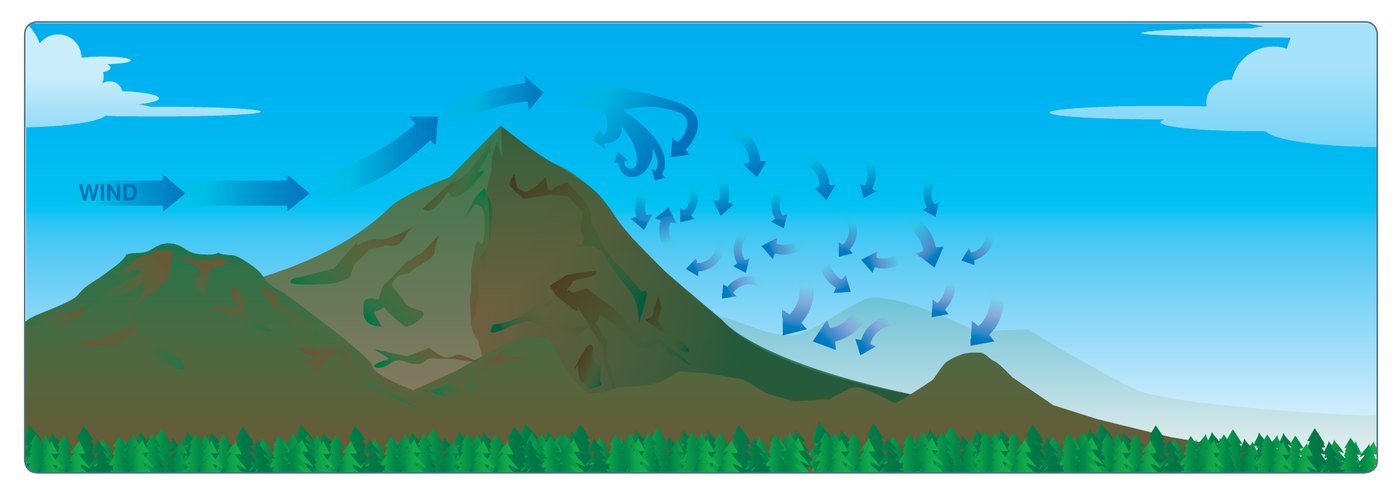
Mountain Waves
When wind blows perpendicular to a mountain ridge with sufficient speed and stable air aloft, it creates a standing wave on the leeward side. The wave can extend hundreds of miles downwind and tens of thousands of feet up.
- Lenticular clouds (Altocumulus Standing Lenticularis): Smooth lens-shaped clouds at the wave crests. They appear stationary while wind pours through them. Always indicate strong wave activity.
- Rotor clouds: Turbulent, ragged-looking clouds that form at low altitude under the wave crests. They rotate around a horizontal axis parallel to the ridge. The rotors themselves can produce extreme turbulence — broken bones in passenger aircraft, structural failure in light aircraft.
- Cap clouds: Clouds that hang over the mountain crest and spill down the leeward side. Indicate strong winds at the summit.
- If the air is dry, none of these clouds form — the dangerous waves and rotors can still be present without any visual warning. Strong wind across a ridge is the only indicator you need.
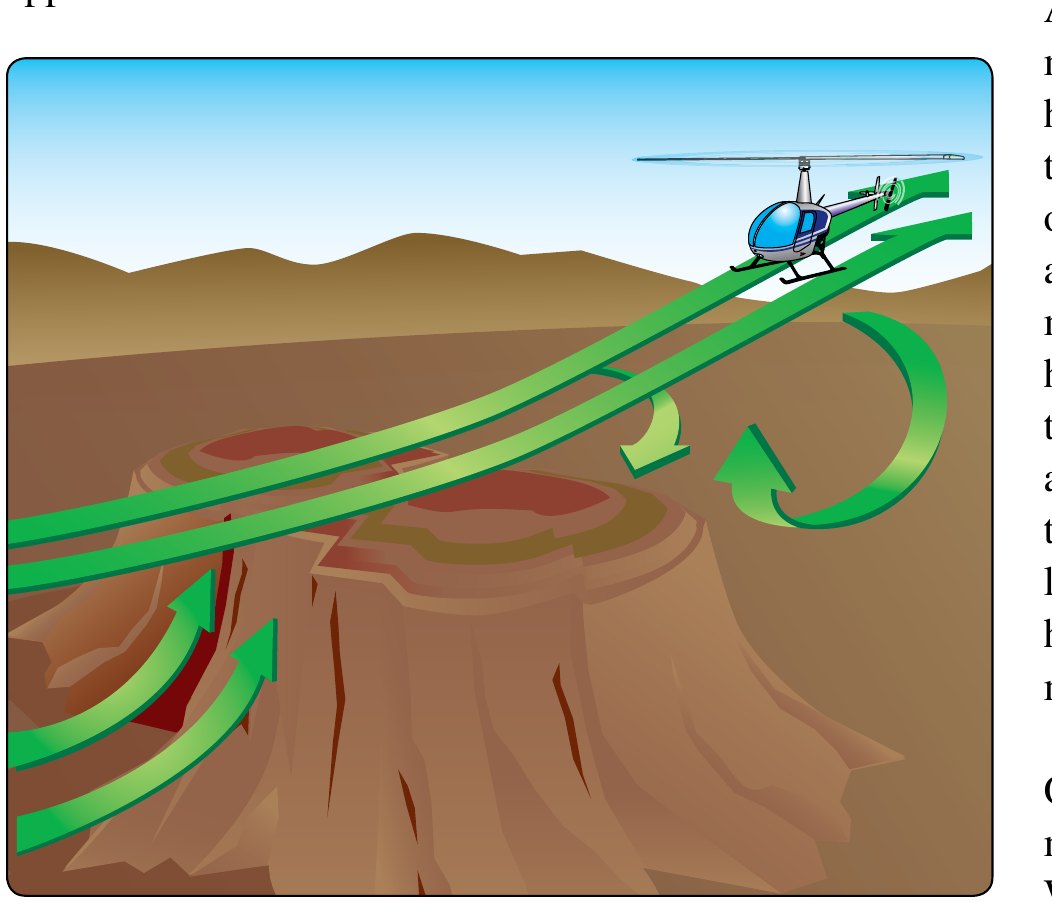
Up-draught, Down-draught, and the Demarcation Line
Wind hitting a hill or ridge produces an up-draught on the windward side and a down-draught on the leeward side. The boundary between the two is the demarcation line.
- As wind speed increases, the demarcation line becomes steeper and shifts toward the windward edge of the feature
- Cross ridges at a 45° angle rather than head-on — gives you an escape turn back into the up-draught if needed
- Approach a ridge crossing on the up-draught side and at altitude — never try to claw your way over from the leeward side
- Smooth hills produce smooth flow; sharp cliffs produce tumbling, turbulent flow over the edge
- Wind forced through a gap or pass accelerates due to the Venturi effect — narrow passes can have wind speeds far higher than the surrounding area
Föhn Effect
A warm, dry wind that blows down the leeward side of a mountain range. Mechanism:
- Air mass is forced up the windward side (orographic lift)
- Air cools 3°C per 1,000 ft until saturated, then 1.5°C per 1,000 ft (latent heat release as moisture condenses)
- Precipitation removes moisture as the air rises
- At the crest, the air has lost most of its water content and has a much lower dew point
- Descending the leeward side, the now-dry air warms quickly at 3°C per 1,000 ft (no longer saturated)
- Result: warm, dry, clear conditions on the leeward side. Often a contributor to wildfires.
Visual hazard: A pilot approaching from the leeward side may see only the silhouette of clouds capping the mountain — but cannot see the full extent of cloud, terrain, or weather on the windward side. Don't commit to a crossing without knowing what's on the other side.
Adiabatic Cooling Rates
- ISA standard lapse rate: 2°C per 1,000 ft — temperature actually measured in the atmosphere
- Dry adiabatic rate: 3°C per 1,000 ft — rising unsaturated air cooling due to expansion
- Saturated (moist) adiabatic rate: 1.5°C per 1,000 ft — rising saturated air cools more slowly because condensation releases latent heat
- Non-standard lapse rate: When measured drops exceed 2°C per 1,000 ft — atmosphere is unstable
Crossing Strategy
- Cross at least 500 feet above the highest terrain — more in strong winds. If you can't make the altitude, divert or find a lower pass.
- Approach at a 45° angle to the ridge — never perpendicular. If sink starts, you can turn into the up-draught instead of being committed to crossing.
- Cross on the up-draught (windward) side and use the lift to gain altitude before committing
- Plan an escape route back into the valley before you commit to any pass
- If the demarcation line is steep, expect strong sink immediately past the ridge — anticipate, don't react
- Helicopters cannot outrun severe down-draught with collective alone — combine collective with airspeed reduction and lateral escape
Hazards Unique to Mountain Helicopter Flight
- Density altitude: The dominant performance limit. Compute hover OGE before every confined-area landing.
- Retreating blade stall: High density altitude lowers the airspeed at which it occurs. Reduce VNE accordingly.
- Vortex ring state: High DA + heavy load + slow approach in a confined area is the textbook setup. Approaches stay shallow and fast in the mountains.
- Loss of tail rotor effectiveness (LTE): High DA reduces tail rotor authority. Avoid downwind hovers and tight pedal turns at low airspeed.
Human Factors in Mountain Flight
- Hypoxia: Difficult to identify in oneself. Causes overconfidence and poor judgment — exactly the wrong attitude for mountain flying. Use oxygen above 10,000 MSL day, 5,000 MSL night.
- Spatial disorientation: Surrounded by high terrain and looking into deep valleys distorts the horizon reference
- Visual illusions: Lack of horizon, false horizons (sloping ridges), white-out / gray-out, and lack of depth perception over uniform snow or terrain
- Apprehension: Nervousness leads to indecision and over-controlling — both deadly in turbulence
- Fatigue: Mountain flying is mentally and physically demanding. Plan rest stops and reasonable flight legs.