

Night Flying
Helicopter night flight introduces a different set of risks: degraded vision, susceptibility to hypoxia, and a catalog of visual illusions that can put a competent pilot upside-down inside of a minute. The CPL practical requires it; commercial flying often demands it.
Night Physiology
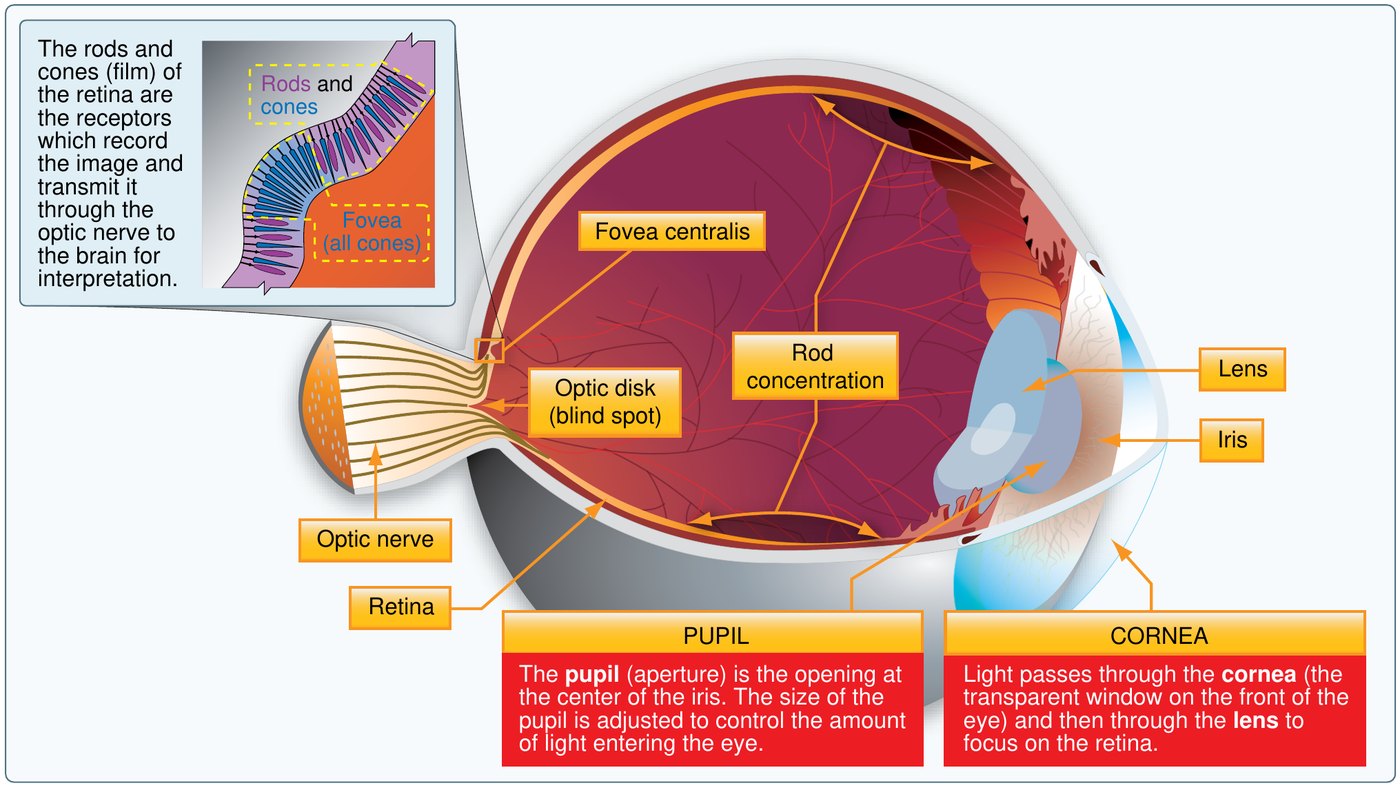
- Cones are concentrated in the fovea (center of vision). They handle color and fine detail, but require strong light. They become inactive in low light.
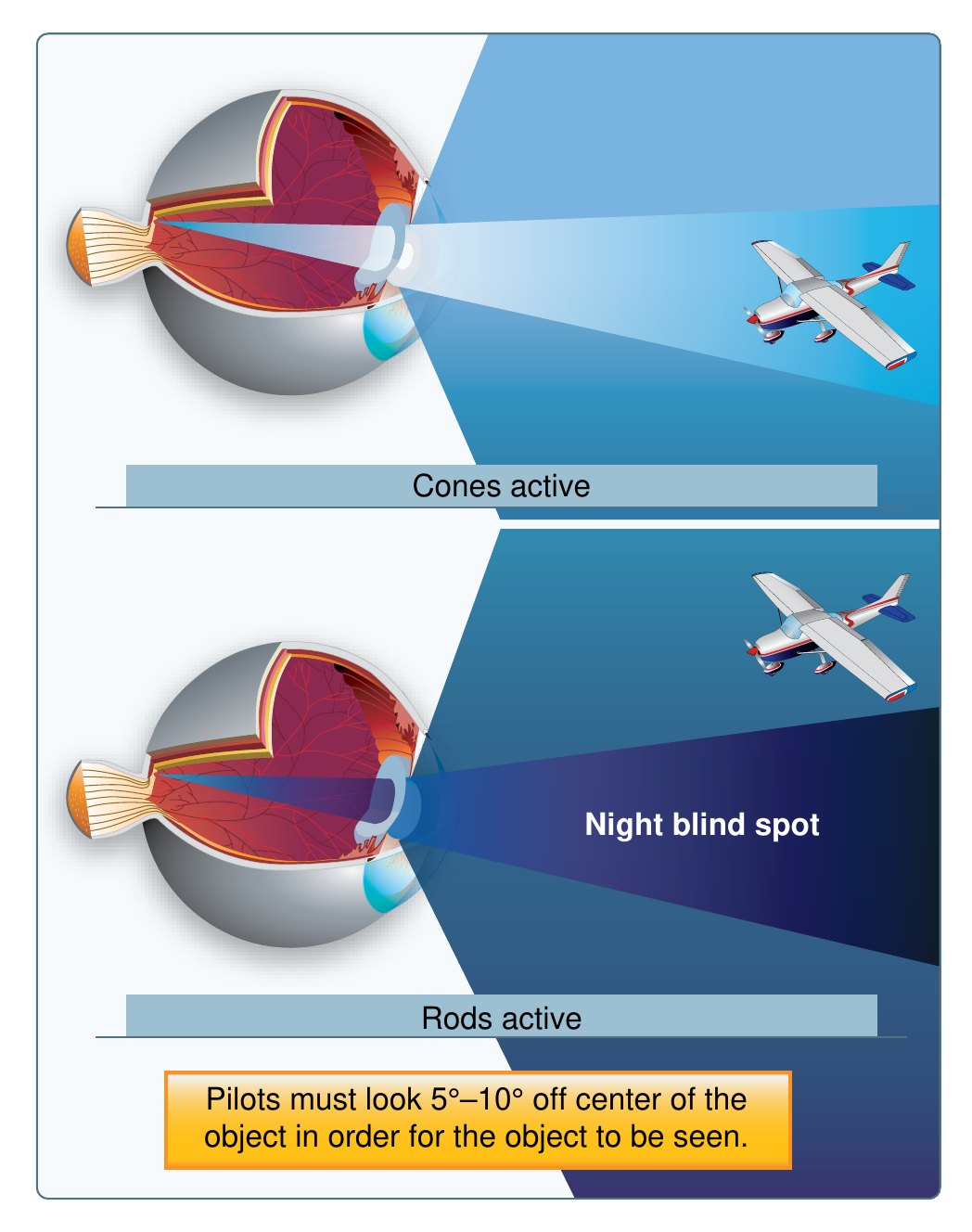
- Rods are concentrated around the periphery. They are the primary night-vision receptors. There are virtually no rods at the center of the eye — creating a night blind spot at the fovea.
- Cones adapt to darkness in 5–10 minutes (~100× more sensitive). Rods take ~30 minutes to fully adapt (~100,000× more sensitive than in light).
- Bright lights destroy dark adaptation in seconds. Dim cockpit lighting and avoid white lights once adapted.
Hypoxia at Night
Vision is one of the first faculties affected by hypoxia. Cabin altitudes as low as 5,000 ft MSL begin to noticeably degrade night vision. Use of supplemental oxygen above 5,000 MSL at night is recommended even though regulations don't require it until 12,500 MSL.
- Avoid self-imposed stressors that worsen night vision: tobacco use, alcohol, low blood sugar, fatigue, dehydration
- Hyperventilation can mimic hypoxia — stay aware of your breathing during high workload
Scanning Techniques
- Use regularly spaced eye movements — small, deliberate scans rather than wide sweeps
- Off-center viewing: Look 5°–10° off the object you want to see. This places its image on the rod-rich periphery rather than the cone-only fovea (the night blind spot).
- Keep eyes moving — staring at a single point causes the image to fade
- Refocus often if flying through clouds or featureless terrain to prevent empty field myopia (eyes default to a focal length of 10–30 ft when there's nothing to focus on)
Airport Beacon Colors
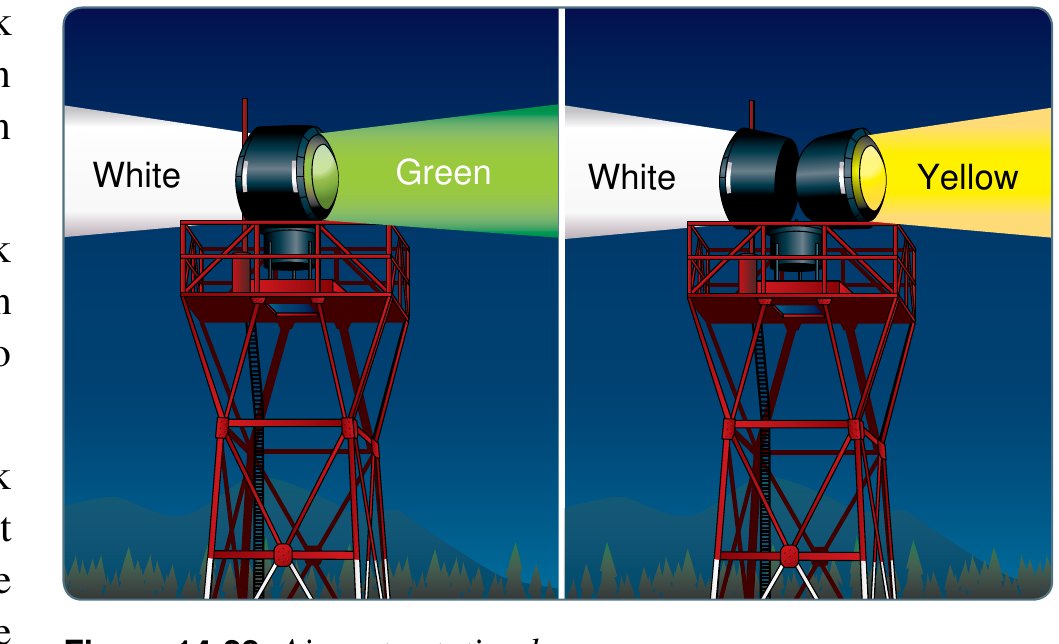
Rotating beacons identify lighted airports at night. Color combinations distinguish airport types:
- Civil land airport: Alternating white and green
- Water airport: Alternating white and yellow
- Heliport: Green, yellow, white
- Military airport: White / white / green — but with dual peaked (two quick) white flashes followed by green, distinguishing it from civil
Use a well-lit runway with a VASI or PAPI for night approaches whenever available — the visual glide slope replaces depth perception that's degraded at night.
Night Visual Illusions — ICEFLAGGS
The mnemonic for the nine somatogyral and visual illusions — one per letter, and the two Gs are two different illusions. Memorize them — and trust the instruments, not your inner ear.
- I Inversion What is happeningAn abrupt change from a climb to straight-and-level flight. What you feelTumbling backwards, which pushes many pilots to shove the nose down.
- C Coriolis What is happeningA head movement — looking down at a chart, up at a switch — during a prolonged constant-rate turn. What you feelRolling, pitching and yawing all at once. The most disorienting of the set; keep the head still in a turn.
- E Elevator What is happeningAn updraft or downdraft with the wings level. What you feelPitching up in the updraft, down in the downdraft.
- F False horizon What is happeningSloping cloud tops, sloping terrain, or a line of ground lights. What you feelThat line is the horizon — and the aircraft gets levelled against it instead of against the real one.
- L Leans What is happeningA bank entered so slowly the canals never registered it, followed by a normal roll-out. What you feelBanked the other way, while the aircraft is in fact level. The commonest of them all.
- A Autokinesis What is happeningA single stationary light stared at for 6–12 seconds in the dark. What you feelThe light is drifting. Pilots manoeuvre to follow it.
- G Graveyard spiral What is happeningA turn held long enough for the fluid in the canals to catch up, with the aircraft descending. What you feelWings level. The altimeter is the only clue — and pulling back only tightens the spiral.
- G Graveyard spin What is happeningRecovery from a spin. What you feelA new spin the other way, so the pilot re-applies the input that started the first one.
- S Somatogravic What is happeningRapid acceleration on takeoff over water or dark terrain (or rapid deceleration). What you feelPitching up — and the instinct is to push the nose over, into the water.
Other Illusions
- Relative motion illusion: A car or aircraft moving in your peripheral vision can give the false sensation that you are moving — common at stops or in formation flight
- Reversible perspective: At night, an aircraft in the distance may appear to be moving away when it is actually approaching. Verify with running lights and trend over time.
- Flicker vertigo: Not strictly an illusion — viewing a flickering light (anti-collision strobe, propeller through the sun) can be distracting and, in rare cases, induce nausea or seizure
- Empty field myopia: Without focal targets, eyes relax to a 10–30 ft focal length, missing distant traffic. Force focal changes by scanning to wing tips, instruments, and back outside.
14 CFR Part 61 Night Currency
- For Part 61 passenger-carrying purposes, "night" means 1 hour after sunset to 1 hour before sunrise
- To carry passengers at night, a pilot must have made 3 takeoffs and 3 full-stop landings at night within the preceding 90 days
- FAR 1.1 defines night more strictly (end of evening civil twilight to beginning of morning civil twilight) — used for logging night flight time
- FAR 1.1 night ≠ FAR 61 night. Know the difference.