

DA/MDA & Visual References
The decision point on every approach: at minima, can you continue or do you go missed? DA/DH on precision approaches is a decision point (momentary descent below allowed during missed). MDA on non-precision approaches is a hard floor (no descent below without visuals + visibility). 14 CFR § 91.175 lists the specific visual references that authorize continuing below minima — memorize them. Plus the rules for sidestep, circling, contact, and visual approaches.
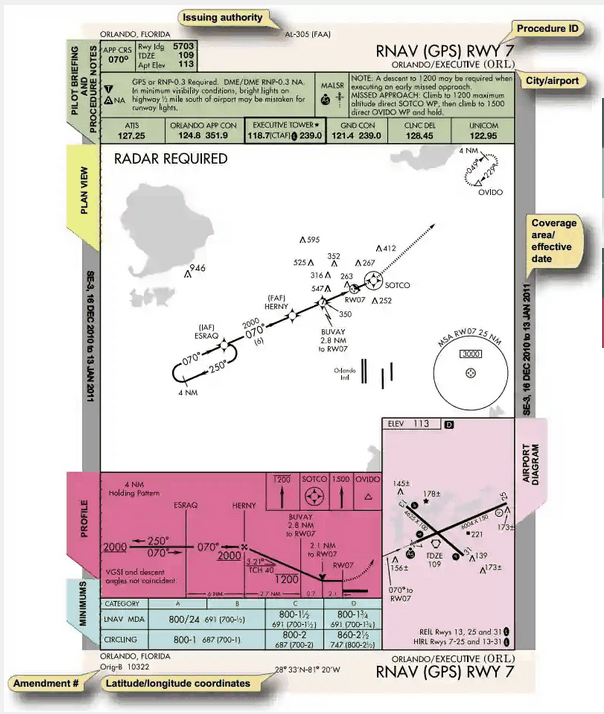
DA/DH vs MDA
- DA (Decision Altitude) / DH (Decision Height): Used on precision approaches (ILS, LPV, LNAV/VNAV). A momentary descent below DA is allowed during the missed approach — DA is a decision point, not a hard floor. Initiate missed if visual references aren't established.
- MDA (Minimum Descent Altitude): Used on non-precision approaches (VOR, LOC, LNAV). Per 91.175, you may not descend below MDA without the required visibility and runway environment. Hard floor.
- VDP (Visual Descent Point): On some non-precision approaches, the point from which a normal descent from MDA may be made provided the runway environment is in sight.
Required visual references — § 91.175
The approach may continue below DA/MDA only when:
- The aircraft is continuously in a position from which a safe landing using normal maneuvers is possible.
- Flight visibility is at or above the minimum prescribed in the IAP.
- One of the following visual references is distinctly visible and identifiable:
- Approach light system (additional limits if only ALS is in sight — descent only to 100 ft above TDZE unless red terminating bars or red side row bars are in sight)
- Threshold, threshold markings, or threshold lights
- Runway end identifier lights (REIL)
- Visual approach slope indicator (VASI / PAPI)
- Touchdown zone, touchdown markings, or touchdown zone lights
- Runway, runway markings, or runway lights
- The VDP is not one of them. Reaching a published visual descent point authorises nothing on its own — it is the point from which a normal descent may be flown once § 91.175(c)(1), (c)(2) and (c)(3) are all satisfied. Without the required visibility and one of the listed references, the MDA is still a hard floor at the VDP and everywhere after it.
If the visual references are lost, execute the missed approach immediately (§ 91.175(e)(1)). There is no bank exception on a straight-in approach below DA/MDA — lose the references and you go missed.
The bank exception people remember is narrower than they remember it. § 91.175(e)(2) applies only during a circling maneuver at or above MDA, and only to seeing an identifiable part of the airport: you go missed when that is not distinctly visible, “unless the inability to see an identifiable part of the airport results only from a normal bank of the aircraft during the circling approach.” It is not a general licence to lose the § 91.175(c)(3) references in a turn.
Sidestep maneuver
Fly an approach to one runway then land on a parallel runway within 1,200 ft laterally. Only allowed when the sidestep was part of the original approach clearance (e.g., "cleared ILS 16R, sidestep 16L"). Initiate as soon as the landing runway environment is in view.
Used at airports with closely-spaced parallel runways where the ILS is on one and traffic flow demands the other.
Circle-to-land
When the final approach is misaligned with the desired landing runway by > 30° (or > 15° for GPS), or when descent gradient from FAF exceeds 400 ft/NM. Indicated on charts by suffix letter A, B, C (no numeric runway suffix — "VOR A" instead of "VOR 16").
- Must remain within the published circling area at or above MDA until in position to descend for landing.
- The circling area accounts for obstacles + 300 ft safety margin.
- Helicopter Cat A circling areas are smaller than Cat B/C/D.
- Circling at night or in marginal visibility is one of the most accident-prone IFR maneuvers — never do it lightly.
Contact & visual approaches
- Visual approach: ATC may clear you when ceilings are at or above 1,000 ft and visibility ≥ 3 SM, and you have the airport or preceding aircraft in sight. Keeps traffic flowing — no need to fly a published approach.
- Contact approach: You must request it — ATC cannot initiate. Allows IFR transition to visual conditions when:
- You can remain clear of clouds
- Flight visibility is at least 1 SM
- You can reasonably expect to continue to the airport in those conditions
- The destination has a published instrument approach
If you ask for a contact approach, be confident you can make it in. There's no published guidance — it's pilot navigation in marginal VMC.
Established on final & CDI sensitivity
Established means: stable on the navigational data with no more than half-scale CDI deflection for an ILS or VOR (5° for an NDB). 14 CFR 91.181 requires the centerline of an ATS route under (a), and under (b) the direct course between the navigational aids or fixes defining any other route — which is the paragraph an approach segment actually falls under. Either way the course is not optional.
CDI accuracy: 5 dots either side of center; each dot represents 2° of course deviation. Linear deviation from a VOR depends on distance:
- 1 NM from station: 1 dot ≈ 200 ft lateral
- 2 NM: 1 dot ≈ 400 ft
- 30 NM: 1 dot ≈ 6,000 ft (1 NM)
- 60 NM: 1 dot ≈ 12,000 ft (2 NM)
A VOR funnels you in: the same dot deflection covers less ground as you approach the station. Fly with a tighter tolerance the closer you get.