

Magnetic Compass
A magnetized bar suspended in fluid that aligns with the local magnetic field. The only navigation reference that doesn't rely on an external power source — fail-safe, but full of errors. Variation, deviation, acceleration error (ANDS), and turning error (UNOS) all conspire to make the compass useful only in level, unaccelerated flight. The pilot's job is to know when to trust it and when to use the heading indicator instead.
The basic instrument
A magnetized bar (or set of magnets) is rigidly attached to a circular card, suspended in a fluid-filled bowl. The fluid damps oscillation. The card floats freely so the magnets align with the earth's magnetic field — and the heading visible at the lubber line is the magnetic heading.
The compass is calibrated for level flight at the latitude of the airport where it was swung. Take it out of those conditions (turning, accelerating, climbing, decelerating) and the errors stack up.
Variation
The difference between true north (geographic) and magnetic north (where the compass points). Published on sectional charts as isogonic lines.
Apply per "East is least, West is best":
- If variation is east (e.g., 10° E), subtract from true to get magnetic. True 270° with 10° E variation = magnetic 260°.
- If variation is west (e.g., 10° W), add to true to get magnetic. True 270° with 10° W variation = magnetic 280°.
Variation is time-dependent — the magnetic poles wander. Sectional charts are updated periodically; old charts have outdated variation data.
Deviation
Local magnetic disturbance from the aircraft's own electrical systems and metal structure. Each compass is calibrated ("swung") for a specific aircraft, and the residual deviation is documented on a compass card mounted on the dash.
The card looks like:
For (mag): N    30   60    E   120  150    S   210  240   W   300  330
Steer:     358  31   59  87   118  149  178  211  240  271  301  330
Read across — to fly magnetic 30°, steer 31° (1° east deviation). Deviation typically varies a few degrees around the dial.
Acceleration error — ANDS
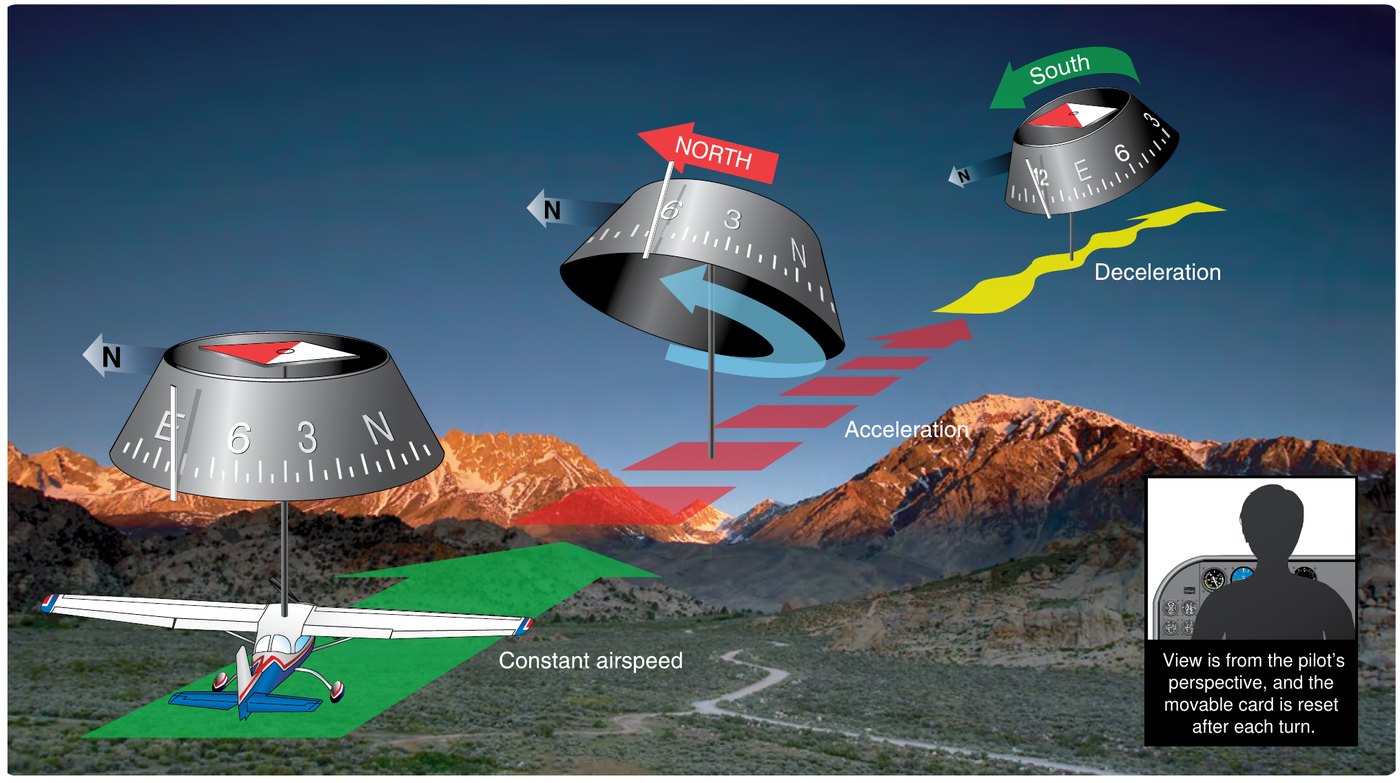
The compass's center of gravity is below its pivot. Inertia tilts the card during acceleration and deceleration on east/west headings. The result:
- Accelerate North — accelerating on an east or west heading shows a turn toward north (compass reads more northerly than actual).
- Decelerate South — decelerating on an east or west heading shows a turn toward south.
No acceleration error on north or south headings. Effect is maximum on east and west.
Turning error — UNOS
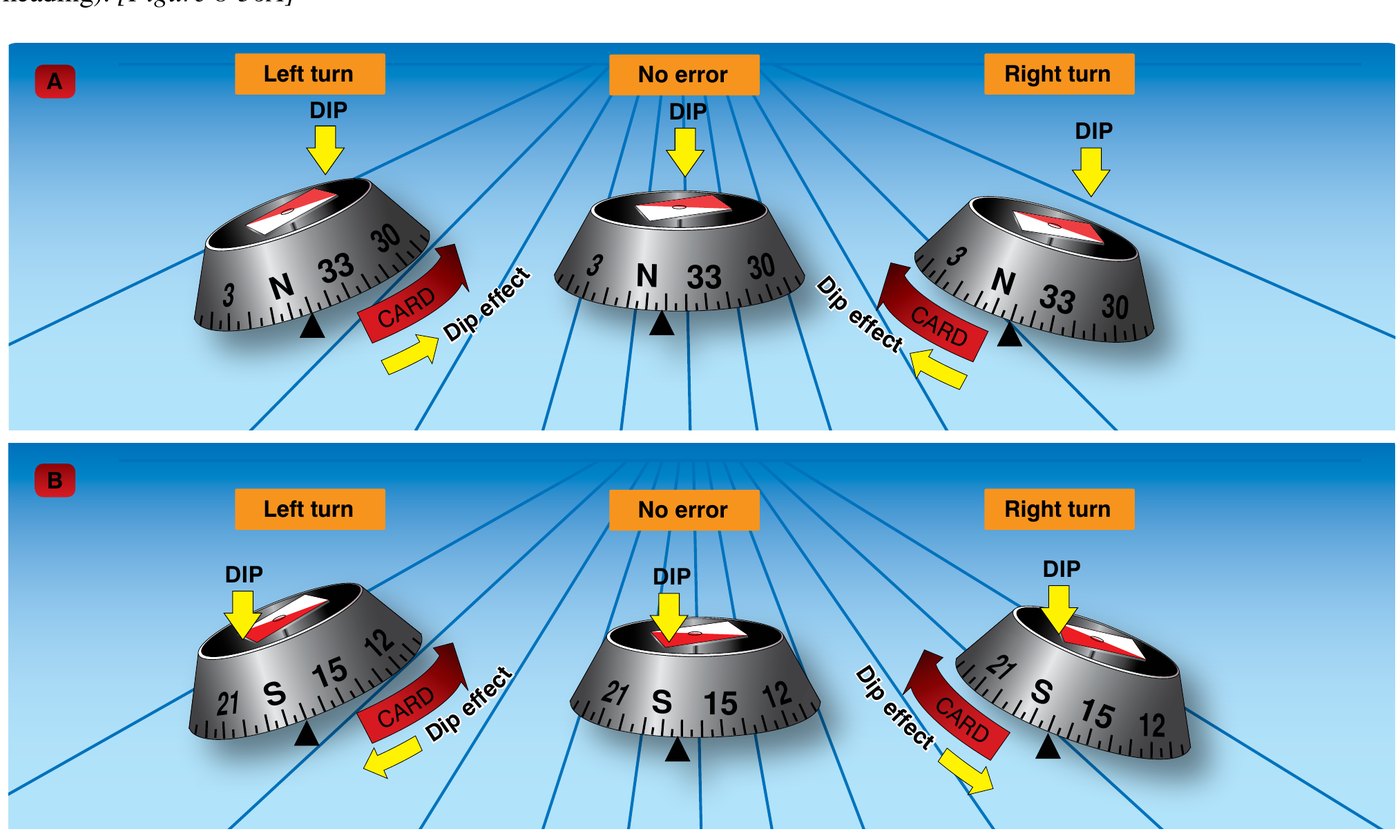
When turning to/from northerly or southerly headings, the compass lags or leads true magnetic heading.
- Undershoot North — when turning to a northerly heading, roll out early by 15° + (latitude / 2).
- Overshoot South — when turning to a southerly heading, roll out late by the same amount.
- No turning error on east or west headings.
- Errors reverse in the southern hemisphere.
Example at 30° N latitude: undershoot/overshoot by 15° + 15° = 30°. Turning to a heading of 360 from east, start the rollout at 330. Turning to 180 from west, continue past 180 to 210 before rolling out.
Practical use — heading indicator backup
Reset the heading indicator using the magnetic compass every 15 minutes in level, unaccelerated flight. If the heading indicator fails, the magnetic compass is your primary heading reference — but only when you're flying straight and level.
Operational discipline:
- Trust the compass during straight, level, unaccelerated flight.
- Distrust it during turns, climbs, descents, accelerations.
- Apply ANDS and UNOS corrections when needed.
- Never make tight turns reading the compass directly — use timed turns or other technique.
The compass is your fallback when the heading indicator dies. Memorize ANDS and UNOS — they show up on every IFR knowledge test.