

Alcohol, Drugs & Fatigue
§ 91.17 says 8 hours bottle-to-throttle, no flight ≥ 0.04 BAC, no flight under the influence — but the hangover effect lasts 8–24 hours past the last drink. § 91.19 prohibits carrying controlled substances. The OTC danger zone — antihistamines, decongestants with pseudoephedrine, sleep aids — quietly disqualifies pilots who don't read labels. Fatigue is its own threat: acute (one bad night) vs chronic (rolling sleep debt), with the Window of Circadian Low between 0200–0600 driving an outsized share of HEMS accidents. The IMSAFE F is doing more work than students realize.
Alcohol — the regulation, then the reality
14 CFR § 91.17(a) states four independent prohibitions — break any one and you've violated the reg:
- No flight within 8 hours of having consumed alcohol ("bottle to throttle"),
- No flight while having a blood alcohol concentration of 0.04 or greater,
- No flight while under the influence of alcohol,
- No flight while using any drug that affects your faculties in any way contrary to safety — § 91.17(a)(3), the one most often left off the list.
§ 91.17(c) makes the test itself compulsory: on request of an authorised law enforcement officer you must submit to a blood or breath test, and on request of the FAA you must release the results. The consequence lives elsewhere — § 61.15(b): committing an act prohibited by § 91.17(a) is grounds for denial of an application for a certificate, rating or authorisation for up to one year, or for suspension or revocation of any certificate you already hold. Note the shape: it is “up to” a year and it bars an application — it is not an automatic one-year ban on acting as a crewmember.
The reality the regulation doesn't say out loud: hangover effects last 8–24 hours past the last drink, well after BAC reaches zero. Hangover impairs reaction time, judgment, and visual scanning at levels that wouldn't show on a breathalyzer. The 8-hour rule is the legal floor, not the safe floor.
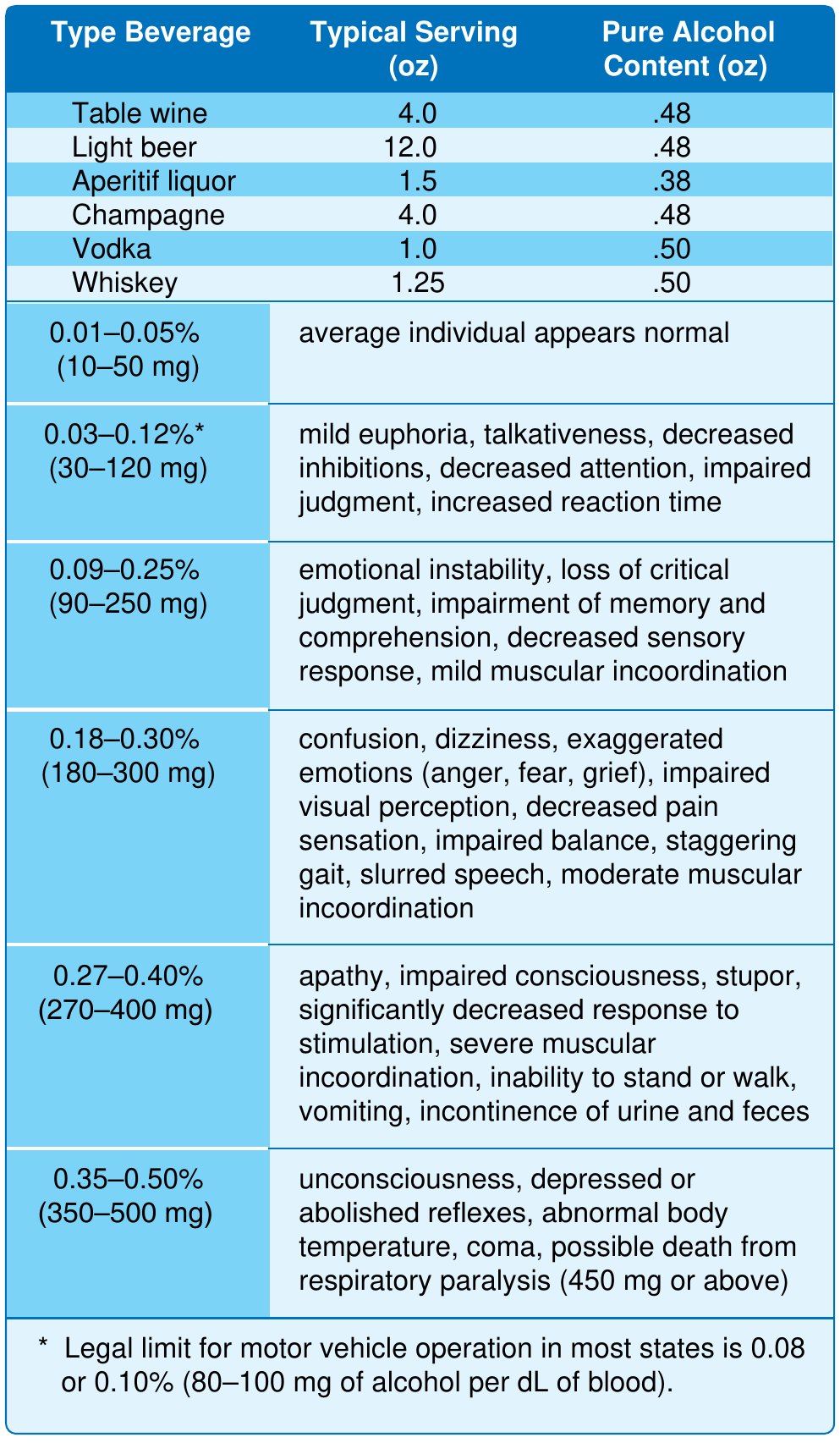
Mechanism: alcohol is a CNS depressant, and at altitude its effects compound with mild hypoxia (alcohol also causes histotoxic hypoxia — see Hypoxia & Altitude). The combination is non-linear: 0.04 BAC at 8,000 ft does not feel the same as 0.04 BAC at sea level.
Drugs — prescription, OTC, and the FAA's "Do Not Issue" list
The carriage rule: 14 CFR § 91.19 prohibits operating a civil aircraft within the United States with knowledge that narcotic drugs, marihuana, or depressant or stimulant drugs or substances — as defined in Federal or State statutes — are carried aboard. The exception in § 91.19(b) is broader than “a prescription”: it covers any carriage authorized by or under any Federal or State statute or by any Federal or State agency. A prescription is one way in; a law-enforcement or medical transport conducted under agency authority is another.
The use rule (in § 91.17(a)(3)): no flight while using any drug that affects your faculties in any way contrary to safety.
The OTC danger zone — products you can buy at any pharmacy that quietly disqualify you under § 61.53 and § 91.17:
- Sedating antihistamines (diphenhydramine / Benadryl, doxylamine / Unisom, chlorpheniramine). Wait at least 5× the dosing interval after the last dose — typically 60+ hours for diphenhydramine. Non-drowsy alternatives (loratadine / Claritin, fexofenadine / Allegra, cetirizine / Zyrtec — used carefully) are usually FAA-acceptable.
- Decongestants with pseudoephedrine can cause jitteriness, increased heart rate, and rebound congestion that triggers ear/sinus blocks (see Hyperventilation & Stress for the related anxiety symptoms).
- Sleep aids (zolpidem / Ambien, doxylamine, melatonin) — even short half-life sleep aids leave residual cognitive impairment well into the next day.
- Opioid pain medications — codeine, hydrocodone, oxycodone. Disqualifying for the duration of use plus a clearance window.
- SSRIs / SNRIs / benzodiazepines — special issuance only, with active AME involvement. Not a self-discoverable answer; consult your AME.
The FAA publishes a Do Not Issue / Do Not Fly list for AMEs — when in doubt, search there or call your AME. The cost of a phone call is much smaller than the cost of an enforcement action or, more concretely, an accident.
Commercial pilots additionally face DOT random drug and alcohol testing under 14 CFR Part 120. Refusal to test or a positive result is a career-ending event.
Fatigue — acute vs chronic, and the WOCL
Fatigue is the most under-recognized and most consequential of the IMSAFE letters. Two flavors:
- Acute fatigue — one bad night. Recoverable with one good night of sleep. Typical: red-eye, late-night call, on-call disruption.
- Chronic fatigue — a rolling sleep debt accumulated over days or weeks of insufficient sleep. Far more dangerous because it builds invisibly and can't be slept off in a single night. Typical: HEMS, ENG, on-call schedules, Part 91 owner-pilots stretching themselves.
The body's circadian rhythm has two physiological troughs: one around 1300–1500 (post-lunch dip) and a much deeper one around 0200–0600 — the Window of Circadian Low (WOCL). During the WOCL, alertness, reaction time, and decision-making are degraded even in well-rested pilots; in fatigued pilots, microsleeps become likely.
NTSB and FAA fatigue data: pilot accidents involving fatigue cluster heavily in the WOCL. HEMS night ops, in particular, have a higher accident rate during 0200–0600 than during any other operating window. This is the physiological reason the FAA issued AC 120-100 (Basics of Aviation Fatigue) and why Part 135 HEMS operators have flight/duty limitations specific to night ops.
The "16-hour awake = 0.05 BAC equivalent" finding (Williamson & Feyer, 2000): cognitive performance after 16+ hours awake measurably matches blood alcohol around 0.05%. After 24 hours awake, you're at roughly 0.10% — illegal to drive in every U.S. state, but no breathalyzer will catch you.
Recognizing fatigue in yourself
The cruel part of fatigue is that it impairs the very faculty you'd use to recognize it. Look for objective signs rather than relying on how alert you "feel":
- Yawning — your body's autonomic attempt to increase oxygen and lower brain temperature. Frequent yawning is a quantitative signal, not a polite gesture.
- Tunnel vision — narrowing of attention to a single instrument or task while ignoring peripheral information.
- Microsleeps — 1–10 second lapses of consciousness, often unnoticed by the pilot. If you've ever "missed" a call or arrived somewhere with no memory of the last few miles, you've had one.
- Increased reliance on familiar routines — flying the same approach the same way without checking that it's the right approach for today's conditions.
- Slowed scan — you're still scanning, but the loop time has stretched. Easy to miss in a helicopter where high workload masks scan degradation.
- Irritability — fatigue impairs emotional regulation before it impairs motor skills. If everything ATC says is annoying you, that's data.
The honest fatigue self-test: "If I were dispatched on this flight by a paying customer right now, would I feel comfortable flying?" If the answer involves rationalization, that's the answer.
Mitigation — what actually works
Listed roughly in order of effectiveness:
- Don't fly fatigued. Cancel, delay, or hand off the flight. Always available, always works.
- Strategic napping. A 20–40 minute nap before a long duty period can restore acute alertness for several hours. Avoid 60+ minute naps before flying — sleep inertia (grogginess) lasts longer than the alertness gain.
- Caffeine, used carefully. Onset 20–40 min, peak around 60 min, half-life 5–6 hours. Useful to bridge a known low point; not a substitute for sleep, and the crash on the back side can be worse than the original fatigue. Don't use within 6 hours of planned sleep.
- Light exposure. Bright light suppresses melatonin and shifts the circadian phase. Useful for pre-conditioning before night ops; harmful if you need to sleep within the next few hours.
- Sleep hygiene — consistent schedule, dark/cool/quiet bedroom, no screens in the last hour, no alcohol close to bedtime (alcohol disrupts REM even at small doses).
- For chronic patterns: talk to your operator's safety officer about FRMS (Fatigue Risk Management System) participation. Part 135 HEMS operators increasingly use FRMS in lieu of pure flight-time limits.
The intersection — alcohol + drugs + fatigue compound
The three rarely show up alone. The "I had two beers and got 5 hours of sleep" pilot is not at 0.00 BAC + acute fatigue — they're at residual alcohol metabolites + REM disruption + acute fatigue, and the combined impairment is nonlinear. Same for OTC sleep aids the night before a 0500 show: residual sedation + the WOCL + acute sleep-debt fatigue stack.
The IMSAFE M, A, and F letters are a unit, not three independent checks. If two of them are marginal, the third has to be a clean pass. If two of them are bad, the answer is no flight.