

Guimbal Cabri G2 — Quick Reference
Performance numbers and limitations for the Guimbal Cabri G2, a common training helicopter. Always verify against your current POH — this is a study reference, not a flight-authoritative document. Numbers can change with service bulletins, type-certificate amendments, and operator-specific limitations.
Also called: Cabri, G2
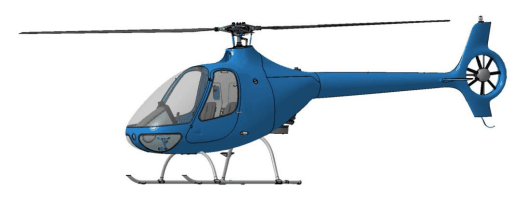
Engine
- Type: Lycoming O-360-J2A — four cylinder, horizontally opposed, direct drive, air-cooled, carbureted
- Power: 160 HP (5-min takeoff) / 145 HP continuous
- Idle: ~1,000-1,200 RPM per POH
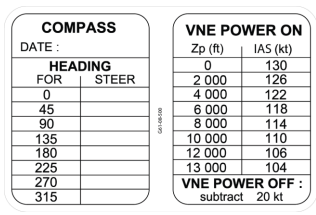
Cockpit placards — VNE and rotor limits at a glance
The Cabri's panel includes airspeed and rotor RPM placards that summarize the limits you need to enforce in flight. These come directly from the certification basis and apply at every power setting.
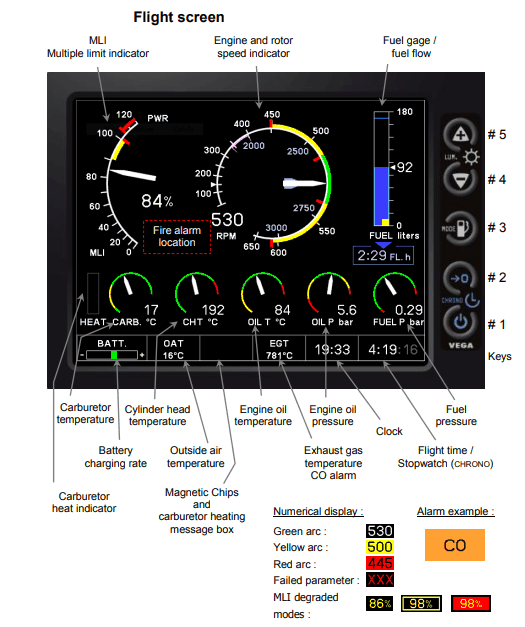
Engine Power Monitor (EPM)
The Cabri's distinguishing instrument is the EPM — a single-display engine and power monitor that consolidates manifold pressure, RPM, oil temperature, oil pressure, CHT, EGT, fuel quantity, and a derived power-margin indication. Unlike a traditional steam-gauge cockpit, the EPM color-codes each reading and surfaces caution and warning conditions automatically. Reading the EPM well is a Cabri-specific skill set; the layout varies slightly between EPM hardware revisions.
V-speeds
- VNE: 130 kt IAS power on, 110 kt IAS power off, each reduced 2 kt IAS per 1,000 ft Zp. The reduction runs from sea level — the RFM sets no 3,000 ft threshold.
- VY (best rate of climb): 50 kts IAS
- Climb speed: 50 kts IAS
- Cruise / max range: 80 kts IAS
Autorotation
- Recommended airspeed: 50 kts IAS (range 30-50 kts)
- Minimum descent rate: 49 kts → ~1,770 fpm
- Best glide: 78 kts IAS
Rotor
- Green arc (rotor RPM): 515-540 RPM
- Three-blade fully articulated main rotor
- Tail rotor: high RPM ratio (~10:1) — vibrations register as high-frequency rather than medium
Hover
- Stabilize at 2 ft skid height for hover-check
Weight & Balance
- Maximum gross weight: 1,543 lb
- Longitudinal CG envelope: the RFM X-axis is positive rearward, so a larger station is further aft — 75.4 in is the forward limit and 83.5 in the aft. It is weight-dependent, not a fixed pair: corners at 1,036 lb @ 83.5 in, 1,102 lb @ 83.5 in, 1,543 lb @ 79.7 in, 1,543 lb @ 75.4 in, 1,213 lb @ 75.4 in. At maximum gross weight the usable range is only 75.4 to 79.7 in; the aft limit opens to 83.5 in at light weights. Work the chart.
The envelope looks odd at first glance only because the Cabri’s datum is forward of the aircraft with stations increasing aft, and because the aft limit moves with weight. There is nothing unusual about the convention.
Oil
- Type: SAE 15W50 normally; straight mineral for first 50 hours of break-in
- Quantity: 4 qt min, 6 qt max
- Temperature: 245°F max
- Pressure: 95 psi (6.6 bar) maximum in flight. The 115 psi figure is the maximum for the starting and warm-up range only.
Fuel
- Type: AVGAS UL91 or 100LL preferred
- Minimum octane: 98
- Required: Zero alcohol content
Wind limits — initial-experience pilots
Operator-specific guidance often applies — many flight schools impose tighter wind limits during initial 200 hours total / 50 hours in type:
- No flight with surface winds > 25 kts including gusts
- No flight with gust spread > 15 kts
These match the conservative envelope used by Robinson R-22 operations as a useful baseline. POH limits may be wider; defer to operator policy.