

Comms & Mandatory Reports
Two communications topics that intersect at the hold: what to do if your radio quits while you're in the pattern, and what events you must report to ATC even when comms are working. The lost-comm procedure is what the EFC time in your DFRATE clearance is for. The MARVELOUS VFR C500 mnemonic catches every pilot-initiated mandatory report — much of which the radar environment makes redundant, but the responsibility never moves to the controller.
Lost communications at a holding fix
If you reach a clearance limit (the holding fix) without onward clearance, ATC expects:
- Maintain the last assigned altitude.
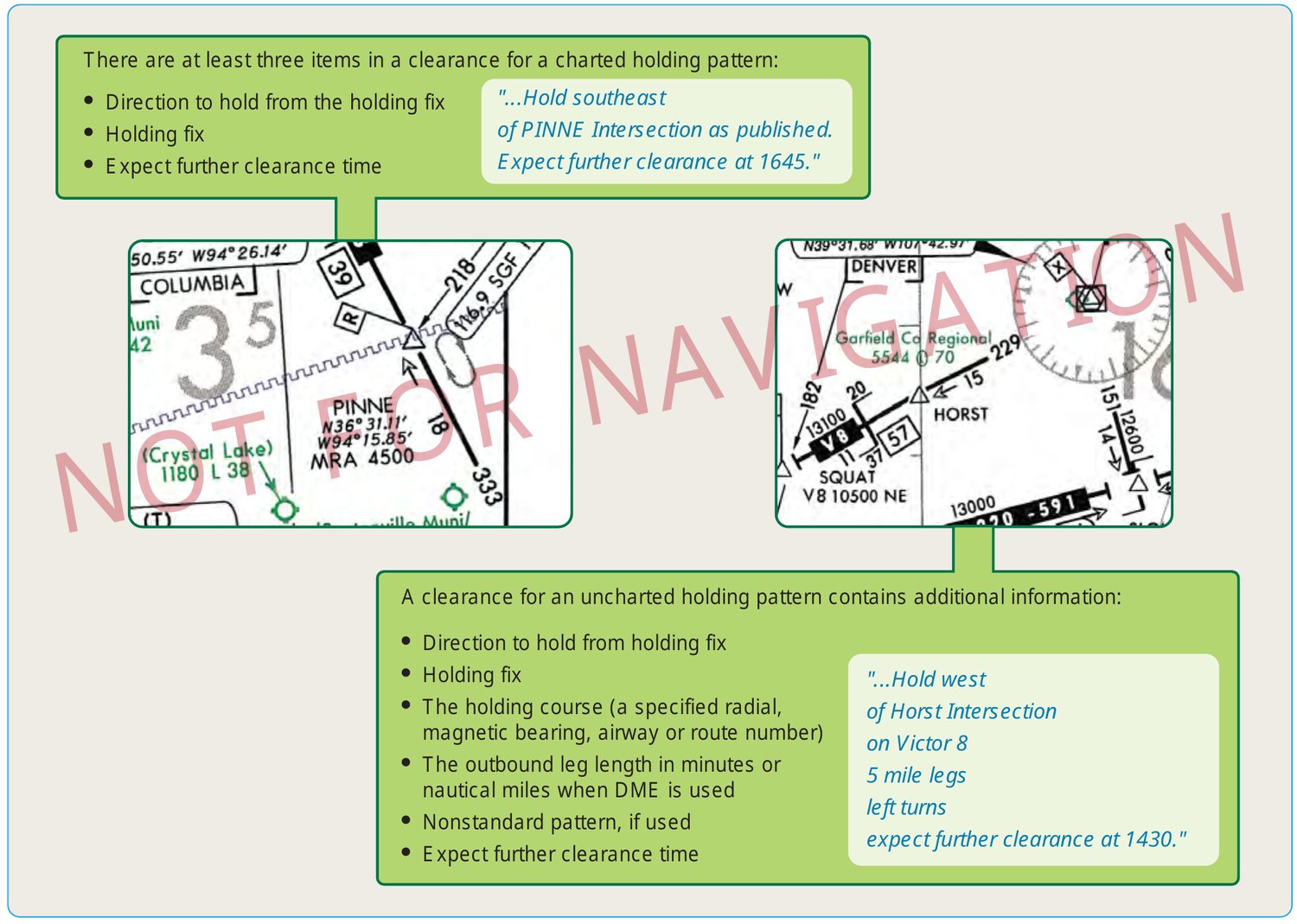
- Begin holding in accordance with the depicted holding pattern (if charted on the approach plate or en-route chart).
- If no pattern is depicted, enter a standard hold on the course you approached the fix on.
- Immediately request further clearance — try 121.5, the previous frequency, the destination tower frequency, etc.
- Always report time and altitude on reaching a holding fix — this is the single most important position fix you can give ATC.
The EFC time from your DFRATE clearance is the lost-comm safety net. If everything goes silent and you reach EFC time without further clearance, you proceed onward as the original clearance contemplates (typically per AVE-F: continue along the route Assigned, Vectored, Expected, or Filed; descent per AVE-F minimum altitudes; arrival at destination at the original or amended ETA).
MARVELOUS VFR C500 — mandatory reports
Even with comm equipment working, certain events must be reported to ATC. The mnemonic catches every one of them. Some apply only in non-radar environments (where ATC can't see your position); others apply everywhere.
- M — Missed approach
- A — Airspeed change of ±max(10 kts, 5%) of filed TAS
- R — Reaching a holding fix (time + altitude)
- V — VFR-on-top altitude change
- E — ETA changed ±2 min (3 min in the North Atlantic) — non-radar only
- L — Leaving a holding fix or holding point
- O — Outer marker (or fix used in lieu of) — non-radar only
- U — Unforecast weather
- S — Safety of flight (emergencies, urgency situations)
- V — Vacating an altitude or flight level
- F — Final approach fix — non-radar only
- R — Radio / nav / approach equipment failure
- C — Compulsory reporting points (depicted as solid triangles on charts) — non-radar only
- 500 — Unable to climb or descend at least 500 fpm
In a radar environment ATC sees most of these directly, so reports like Outer Marker / FAF / Compulsory points become redundant. But the responsibility to report doesn't shift to the controller — if you're flying somewhere where radar coverage is intermittent, expect to be back to non-radar reporting without warning.
Squawk codes during a comm-loss event
If your radios fail entirely, set the transponder to 7600 immediately. ATC sees the lost-comm flag instantly and starts coordinating with controllers downstream. Continue the lost-comm procedure (maintain altitude, hold per pattern, EFC time logic) until you can re-establish communications or arrive at destination.
If the lost-comm event is also a true emergency (engine, fire, etc.), 7700 takes precedence over 7600. ATC handles 7700 differently and will assume your inability to communicate is part of the larger emergency.