

Emergency Equipment & Communications
The meta-skill that wraps every other emergency. The aircraft cuts you off from help; communications and equipment put you back on the grid. Squawk codes, the emergency frequency, the Mayday call structure, and the ELT — none of these solve the underlying problem, but all of them dramatically shorten the time between "engine quit" and "rescue arrives."
Transponder emergency codes
Three special codes a controller sees as soon as you set them — even before you call:
- 7700 — Emergency. Any nature of emergency. Squawking 7700 lights up the controller's scope and prioritizes your aircraft. Set this any time you're declaring an emergency or believe you may need to.
- 7600 — Lost communications. Set when your radios have failed but the rest of the aircraft is operating normally. Continues to work with secondary radar.
- 7500 — Hijack / unlawful interference. Set silently if you can; the controller's response is different from 7700.
Mnemonic: 7500 taken alive, 7600 can't communicate, 7700 going to heaven. Crude, but the order — 7500, 7600, 7700 — is reliable and the rhyme sticks.
If you change codes from a previously assigned squawk, set the emergency code as soon as you have a free hand; the controller will see the new code instantly. You don't need permission to squawk 7700.
121.5 MHz — the emergency frequency
121.5 MHz is the international VHF emergency frequency, monitored by ATC, GARD satellites, and most aircraft.
- If you're already in contact with a controller, declare on the frequency you're using. Switching to 121.5 means re-establishing communications you already have.
- If you're VFR and not talking to anyone, switch to 121.5 and call. Any controller who hears it will respond and coordinate.
- If your active frequency stops working, 121.5 is the fallback. ATC, en-route aircraft, and search-and-rescue all monitor it.
Some helicopters carry a second VHF or a backup handheld; a handheld monitoring 121.5 is one of the better preparedness items in mountain or remote-area flying.
The Mayday call
"Mayday" is the international distress call — used for grave and imminent danger. "Pan-Pan" (also internationally standardized) signals urgency without imminent danger. Both are spoken three times in succession.
Standard Mayday format — say it slow, say it twice if you can:
"Mayday Mayday Mayday,
[your callsign],
[your position — VOR radial, distance from a known fix, or lat/long],
[nature of emergency — engine failure, fire, etc.],
[souls on board],
[fuel remaining in time, not gallons],
[intentions — autorotation to field, returning to airport, etc.]"
Real call examples:
- "Mayday Mayday Mayday, helicopter Robinson 4-2-3 Tango Charlie, 5 miles south of KAPC at 1,200 feet, engine failure, two souls, 30 minutes fuel, autorotating to a field on the east side of Highway 29."
- "Pan-Pan Pan-Pan Pan-Pan, helicopter 12 Echo, 10 miles north of KSAC, generator failure, returning to KSAC, two souls, 40 minutes fuel."
If you have time, repeat the position information — controllers may not catch it the first time and a position fix is the most useful piece of information for rescue. If you're descending and won't have a working radio at the bottom, prioritize getting position out first.
ELT — Emergency Locator Transmitter
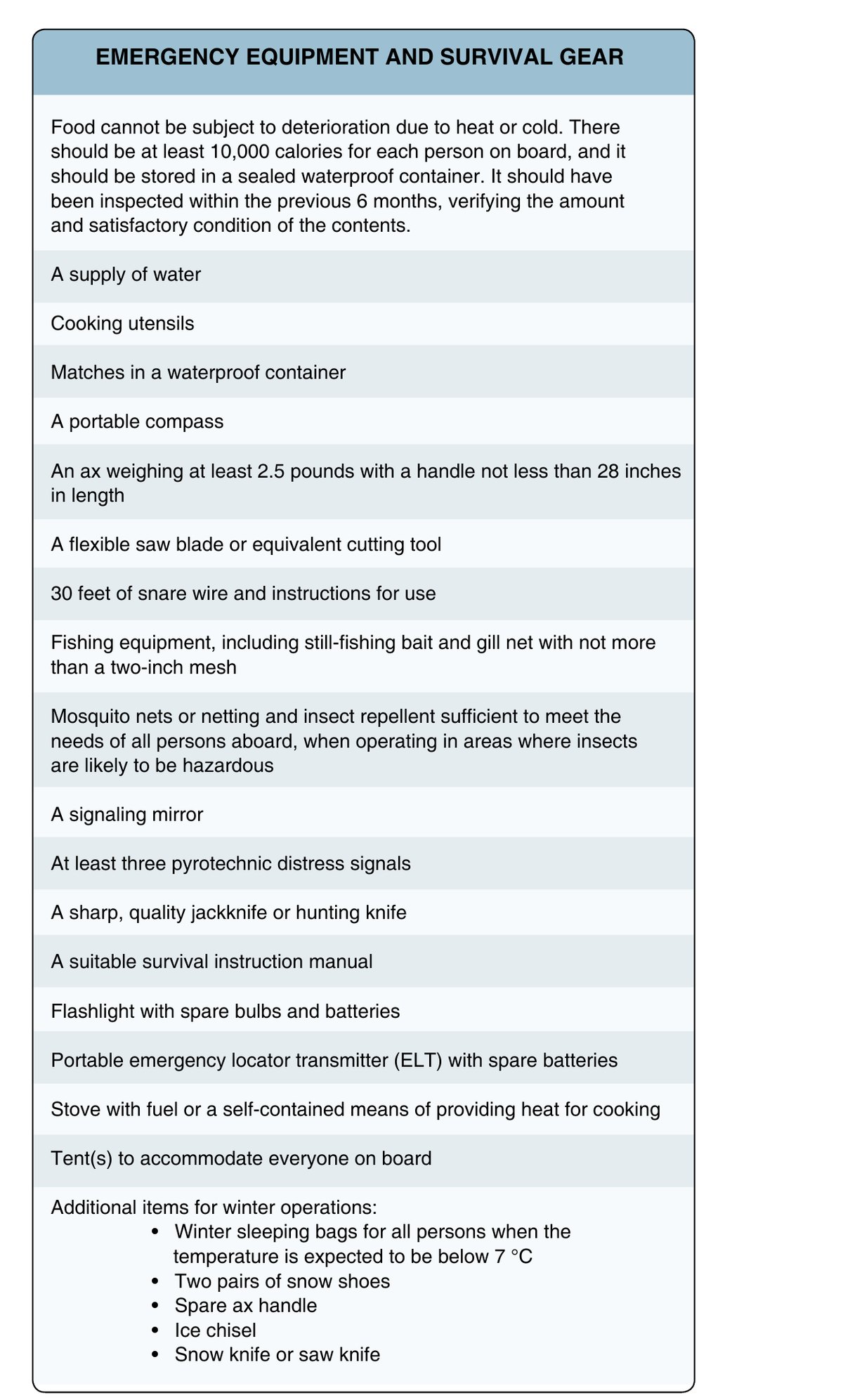
§ 91.207(a) is written for airplanes — its ELT requirement does not reach a helicopter, and § 91.205(b)(15) only calls for one “if required by § 91.207.” Plenty of helicopters carry one anyway, and other rules can require it for particular operations, so know what is installed in yours rather than assuming either way. Activates automatically on impact (G-switch), or can be turned on manually. Transmits on 121.5 MHz (older units) and/or 406 MHz (newer units, satellite-detected with GPS position).
- Know where yours is — typically tail boom or aft cabin. Check during preflight that the test indicator (if equipped) is functional.
- Know how to turn it on manually — the panel switch (if present) or the unit itself can be activated by hand if a survivable landing didn't trigger the G-switch.
- Know how to turn it off — false activations are common (rough landings, hard ramp handling). If your ELT goes off accidentally on the ground, call the nearest FSS and turn the unit off.
- Battery duration — typically 24–48 hours for a 406 MHz unit on full transmit. Plan rescue timelines accordingly.
The 406 MHz upgrade is significant: the older 121.5 MHz units are no longer satellite-monitored (since 2009). 406 MHz units include a unique digital ID, optional GPS position, and direct satellite alerting to rescue coordination centers. If your aircraft still has a 121.5-only ELT, the upgrade to 406 is one of the highest-value safety investments available.
Practice priorities — when seconds matter
If the emergency is bad enough that you have time only for one action, the priority order is:
- Aviate — fly the aircraft. Communications come second.
- Squawk 7700 — one knob turn, no words required.
- Mayday call — if you can manage it without abandoning aviate.
- ELT manual activation — if a forced landing is imminent and the G-switch may not trigger.
The classic "aviate, navigate, communicate" priority applies — but in the modern transponder era, squawking 7700 is so cheap (one button on most modern transponders) that it shouldn't be skipped even when time is short.