

Airspace Classes
Six classes (A–E controlled, G uncontrolled) plus special-use overlays. Each class has its own entry rules, equipment requirements, and speed limits. The PPL standard is being able to identify any chart-depicted airspace at a glance and recite its rules cold. Reference: AIM Chapter 3 — Airspace and 14 CFR Part 71.
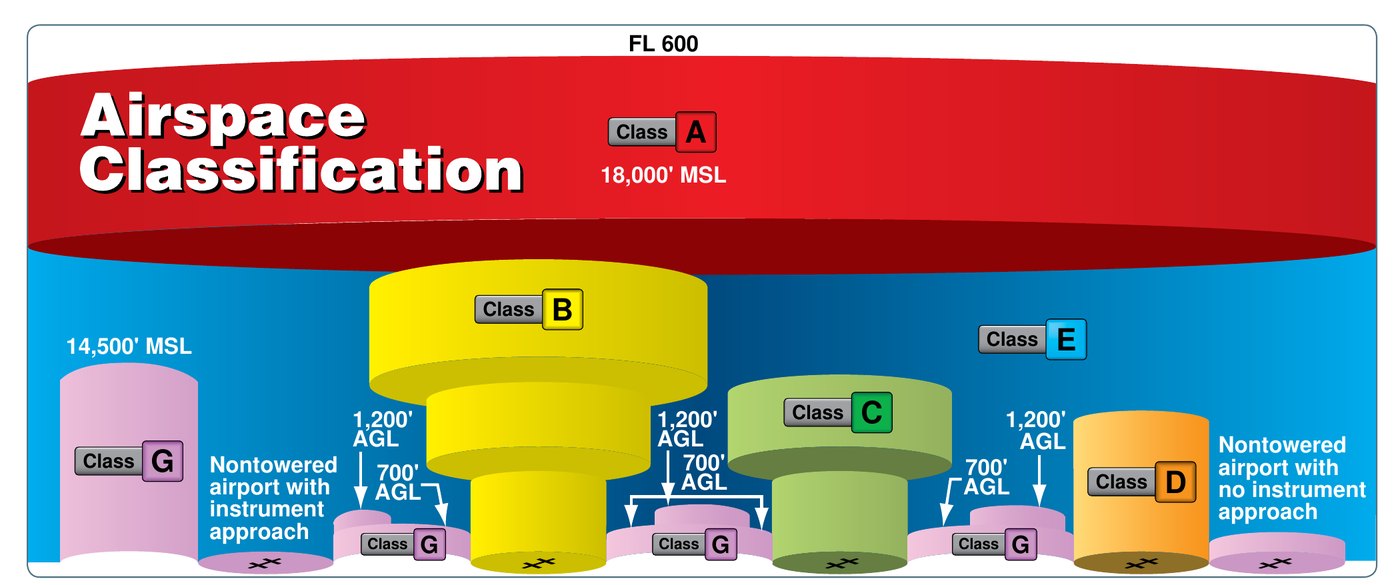
Class A — § 71.33
- Vertical limits: 18,000 ft MSL up to and including FL600 (§ 71.33 says “to and including FL600” — FL600 itself is Class A, not the airspace above it).
- Entry: IFR clearance only — no VFR ops permitted.
- Equipment: Two-way radio, Mode C transponder, ADS-B Out (per § 91.225).
- Helicopter operations in Class A are rare — most civil rotorcraft don't have the service ceiling. Some twins (S-92, AW139) operate IFR in Class A on offshore platform routes.
Class B — § 71.41
- Around major hubs (~37 in the US — JFK, LAX, ATL, etc.). Inverted "wedding cake" with shelves at progressively higher floors moving outward.
- Entry: ATC clearance required — must hear "Cleared into the Class Bravo." A handoff or "radar contact" alone is not a clearance.
- Equipment: Two-way radio, Mode C transponder, ADS-B Out.
- Pilot certificate: Private (or student with required endorsement per § 61.95); solo students may not take off or land at the airports listed in 14 CFR Part 91, Appendix D, Section 4 — the bar comes from § 91.131(b)(2), and at those airports the PIC must hold at least a private pilot certificate. (The list is in the regulation itself, not in FAA Order JO 7400.2.)
- Speed limits: 250 KIAS within Class B; 200 KIAS under the shelf or in a VFR corridor (per § 91.117).
- VFR weather mins: 3 SM, clear of clouds.
Class C — § 71.51
- Around medium-traffic airports with a tower, radar approach control, and certain traffic counts. Two-ring "wedding cake" — 5 NM core (surface to 4,000 AGL) + 10 NM outer ring (1,200–4,000 AGL).
- Entry: Two-way radio contact with the controlling facility. Clearance is not explicitly required — but if the controller doesn't say your N-number, you don't have contact.
- Equipment: Two-way radio, Mode C transponder, ADS-B Out.
- Speed limits: 200 KIAS within 4 NM of the primary airport at or below 2,500 AGL.
- VFR weather mins: 3 SM, 1,000/500/2,000 (1 below / 500 above / 2,000 horizontal).
Class D — § 71.61
- Around tower-controlled airports without radar approach control. Typically a 4–5 NM radius cylinder, surface to 2,500 AGL.
- Entry: Two-way radio contact before entering. Same "your N-number must be acknowledged" rule as Class C.
- Equipment: Two-way radio. No transponder required by Class D itself — but check whether you are inside the 30 NM Class B Mode C veil, or above the ceiling of a Class B or Class C under § 91.215(b)(4). There is no 30 NM veil around Class C.
- Speed limits: 200 KIAS at or below 2,500 AGL within 4 NM of the primary airport.
- VFR weather mins: 3 SM, 1,000/500/2,000.
- Class D becomes Class E (or G) when the tower closes — listen to ATIS for the part-time hours.
Class E — § 71.71
- Controlled airspace not designated A, B, C, or D. Most en route airspace in the US is Class E.
- Floors:
- Surface (around airports with instrument approaches, dashed magenta border)
- 700 AGL (faded magenta vignette, around most uncontrolled airports)
- 1,200 AGL (faded blue vignette — the default away from airports)
- 14,500 MSL (everything above this is Class E up to 18,000 unless otherwise designated)
- Entry: No clearance or contact required for VFR — but you must meet the weather minimums per § 91.155.
- VFR weather mins (below 10,000 MSL): 3 SM, 1,000/500/2,000.
- VFR weather mins (at and above 10,000 MSL): 5 SM, 1,000 above / 1,000 below / 1 SM horizontal.
Class G — uncontrolled
- Below the Class E floor — surface to 700 AGL or 1,200 AGL depending on the chart.
- No ATC service. No clearance or contact required for VFR or IFR (yes, IFR in Class G is legal — just unwise without ATC).
- VFR weather mins (day, ≤ 1,200 AGL): 1 SM, clear of clouds. Helicopters may use ½ SM clear of clouds under § 91.155(b)(1), but only in an airport traffic pattern within ½ mile of the runway or helipad of intended landing — not as a general Class G allowance.
- VFR weather mins (night, ≤ 1,200 AGL): 3 SM, 1,000/500/2,000. Helicopters at speeds permitting see-and-avoid: 1 SM, clear of clouds.
- Above 1,200 AGL Class G transitions back to standard mins (3 SM, 1,000/500/2,000 day; 3/1k/500/2k night).
Full helicopter exception detail on VFR Weather Minimums.
Mode C veil & ADS-B rule
- Mode C veil: 30 NM around a Class B primary airport — § 91.215(b)(2) puts it precisely: all airspace within 30 NM of an airport listed in Part 91 Appendix D, Section 1, from the surface upward to 10,000 ft MSL. It applies whether or not you enter the Bravo, but it is not “regardless of altitude” — above 10,000 MSL the veil itself stops, and (b)(4) takes over above the ceiling of the Class B or Class C.
- ADS-B Out (§ 91.225): Required in Class A; in Class B and C; in the Mode C veil; in Class E at and above 10,000 MSL (excluding airspace at and below 2,500 AGL); above the ceiling and within the lateral boundaries of Class B/C up to 10,000 MSL; over the Gulf of Mexico above 3,000 MSL within 12 NM of the coast.
- Most light helicopters now carry an ADS-B Out installation — confirm IFR/VFR capability with your specific avionics.