

VFR Weather Minimums
"Can I legally fly VFR right now?" The answer is in 14 CFR § 91.155 — five visibility-and-cloud-clearance combinations by airspace class — and the helicopter exception that loosens the Class G floors. Plus Special VFR (§ 91.157) for the ATC-cleared scenario where the field is below normal mins. The PPL test pulls heavily from this section; commit it to memory.
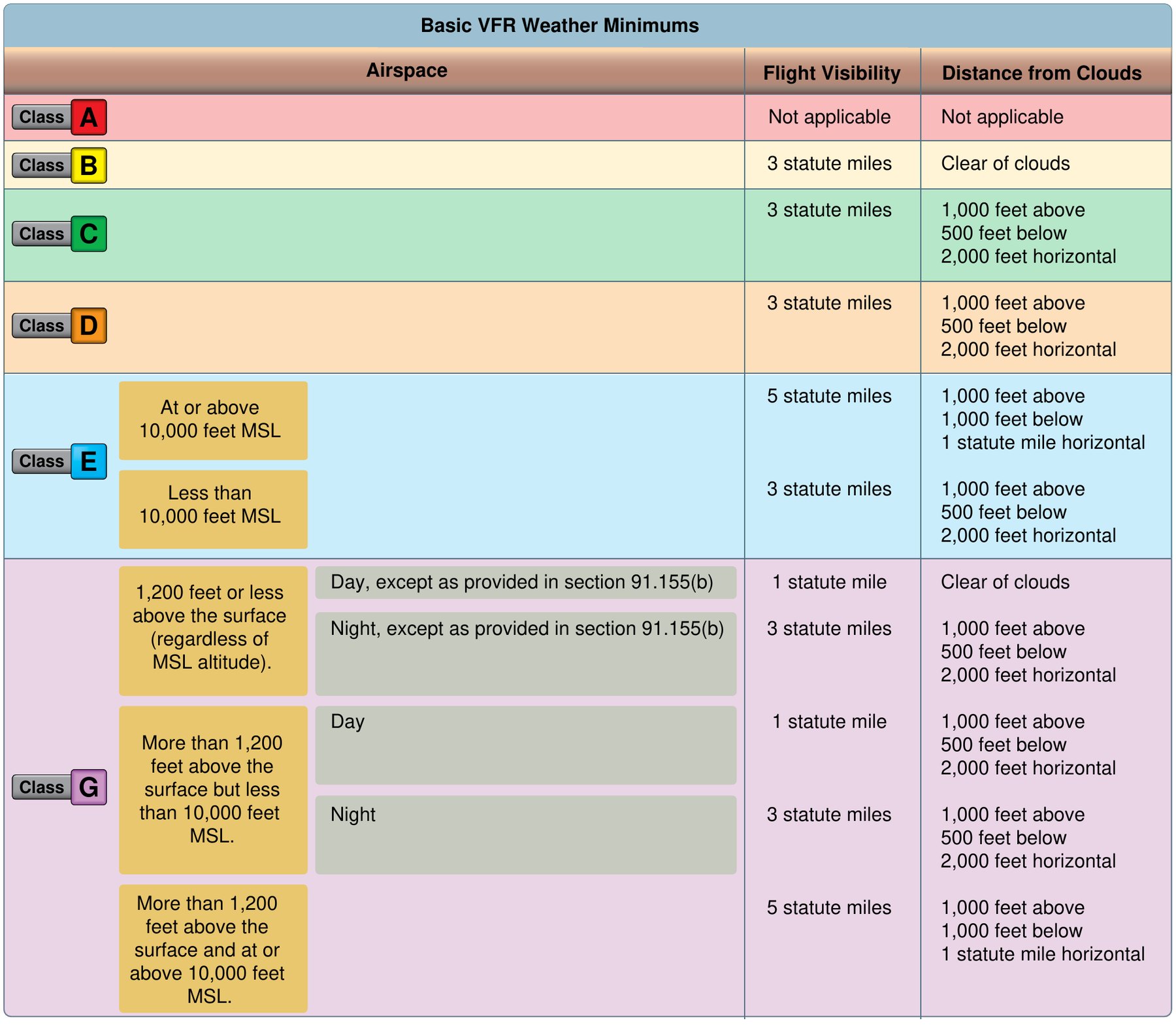
The standard table — § 91.155
| Airspace | Visibility | Cloud clearance |
|---|---|---|
| Class A | N/A (IFR only) | N/A |
| Class B | 3 SM | Clear of clouds |
| Class C, D | 3 SM | 1,000 above / 500 below / 2,000 horizontal |
| Class E (< 10,000 MSL) | 3 SM | 1,000 / 500 / 2,000 |
| Class E (≥ 10,000 MSL) | 5 SM | 1,000 above / 1,000 below / 1 SM horizontal |
| Class G ≤ 1,200 AGL day | 1 SM | Clear of clouds |
| Class G ≤ 1,200 AGL night | 3 SM | 1,000 / 500 / 2,000 |
| Class G > 1,200 AGL day, < 10,000 MSL | 1 SM | 1,000 / 500 / 2,000 |
| Class G > 1,200 AGL night, < 10,000 MSL | 3 SM | 1,000 / 500 / 2,000 |
The "1-500-2000" pattern is the PPL exam mnemonic — three numbers, in that order. At 10,000+ MSL it switches to "1-1000-1SM" (the 1-1-1 rule) because high-altitude jet traffic at 250+ KIAS needs more separation.
Helicopter exception — § 91.155(b)(1)
- The relief is narrow. § 91.155(b)(1): in Class G below 1,200 ft AGL, a helicopter may be operated clear of clouds with flight visibility not less than ½ statute mile — but only in an airport traffic pattern within ½ mile of the runway or helipad of intended landing.
- Outside that pattern the ordinary Class G table in § 91.155(a) applies in full, and there is no day/night split and no “speed that allows see-and-avoid” condition in the current paragraph. Both of those were the pre-2014 wording, replaced by Amendment 91-330. Study material still quoting them is out of date.
- Class B/C/D/E: same minimums as fixed-wing — 3 SM and 1-500-2000 below 10,000 MSL.
The helicopter exception is a real legal advantage — but legal does not mean safe. Most CFITs in helicopters happen at minimums the regs allow. Use the exception when operationally justified, not as an excuse to launch into deteriorating weather.
Special VFR — § 91.157
When the field is below normal VFR minima inside Class B/C/D/E surface area, ATC may issue a Special VFR clearance:
- Visibility: 1 SM (fixed-wing). Helicopters: no minimum visibility — visibility low enough for safe see-and-avoid is acceptable.
- Clouds: Clear of clouds.
- Pilot: Must hold an instrument rating to operate SVFR at night (sunset to sunrise) per § 91.157(b)(4) — and the aircraft must be IFR-equipped. Helicopters are exempt from the night SVFR pilot/aircraft requirement.
- Clearance: Required from ATC. Request "Special VFR clearance to depart [airport]" — controllers handle SVFR on a workload-permitting basis.
- SVFR is not available at airports where the chart annotation says "NO SVFR". These are typically large hubs where SVFR would interfere with IFR flow.
The night-SVFR helicopter exemption is one of the genuine "rotorcraft advantages" in the FAR. EMS, law-enforcement, and tour ops use it routinely — but the responsibility scales: SVFR at night in fog is one of the highest-fatality scenarios in helicopter aviation.
3-152 / 5-111 mnemonic
The cloud-clearance numbers cluster into two patterns:
- 3-152 (below 10,000 MSL controlled): 3 SM, 1,000 above, 500 below, 2,000 horizontal
- 5-111 (at and above 10,000 MSL): 5 SM, 1,000 above, 1,000 below, 1 SM horizontal
Class G ≤ 1,200 AGL day: 1 SM, clear of clouds ("121-COC"). Easy to remember by exception, since this is the only "clear of clouds" condition outside Class B and the helicopter rules.