

Flight Planning
Pre-flight planning starts with a sectional and a plotter, runs through E6B / ForeFlight wind correction and fuel math, and ends with a filed flight plan and brief. Pilotage and dead reckoning are the in-flight techniques. The PPL standard is doing all of this manually before relying on the iPad. Required preflight per 14 CFR § 91.103; reference: FAA-H-8083-25 PHAK Ch. 16.
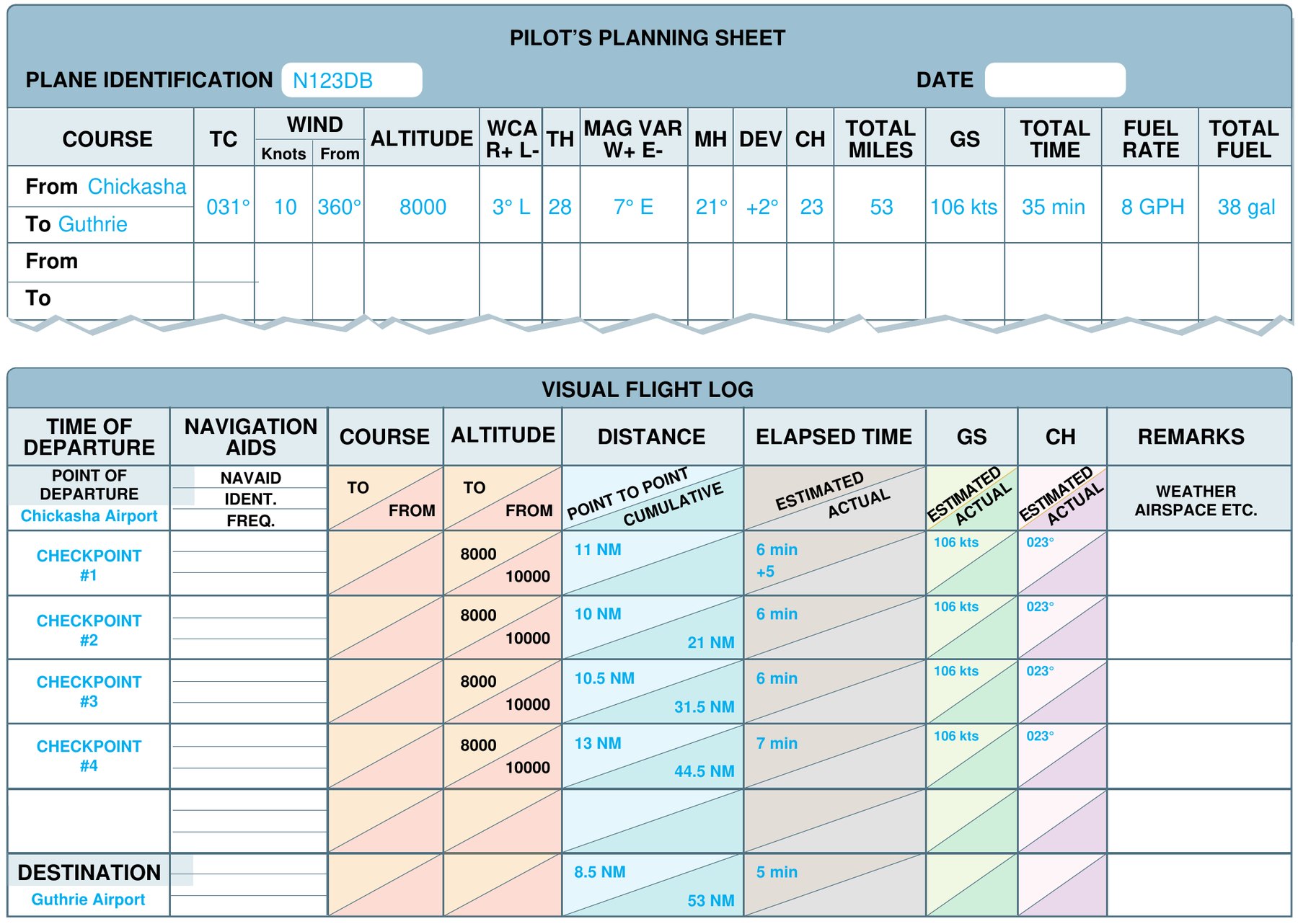
The course chain — true → magnetic → compass
Plot a course on the sectional with a plotter. The number you measure off the chart is your true course (against true north — the longitude lines). To get to a heading you can fly:
- True course (TC) — measured off the chart.
- True heading (TH) = TC ± wind correction angle (WCA). Use an E6B or ForeFlight to compute WCA from forecast winds aloft.
- Magnetic heading (MH) = TH ± variation. Variation comes from the isogonic line on the sectional. "East is least, West is best" — east variation subtracts; west adds.
- Compass heading (CH) = MH ± deviation. Deviation comes from the compass correction card in your aircraft (different at each cardinal heading).
The full mnemonic: "True Virgins Make Dull Companions" — True → Variation → Magnetic → Deviation → Compass. Or "Cans Of Beer Cause Trouble" running the other direction (Compass → Deviation → Magnetic → Variation → True).
Wind correction & groundspeed
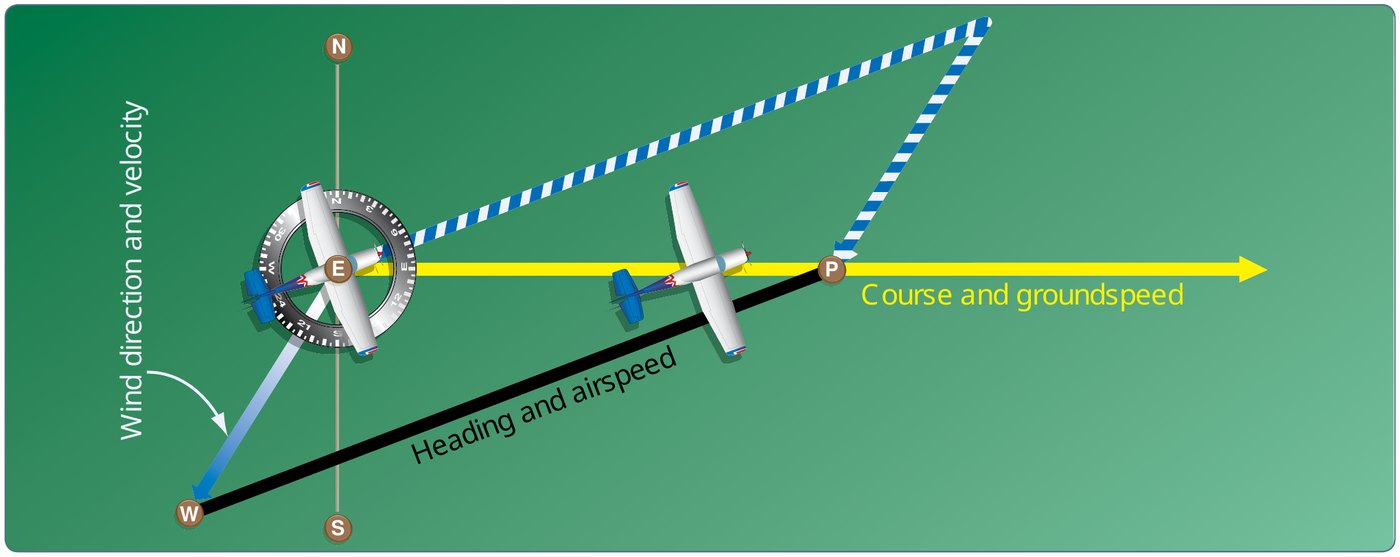
- Forecast winds aloft — get from aviationweather.gov/winds (FB / FD products) or via 1-800-WX-BRIEF.
- For each leg, use an E6B (manual or electronic) to compute:
- Wind correction angle (WCA) — how far to crab into the wind to track the desired course
- Groundspeed (GS) — true airspeed adjusted for headwind/tailwind component
- Estimated time enroute (ETE) — leg distance ÷ groundspeed
- Cross-check in flight: compare GPS groundspeed to your planned groundspeed. A meaningful difference means winds aren't what was forecast — adjust your fuel and ETA accordingly.
- ForeFlight, Garmin Pilot, and SkyVector all do these computations automatically — but the PPL exam expects you to do them by hand at least once.
Fuel planning
- Fuel burn × ETE = leg fuel. Sum across all legs for total trip fuel.
- Add legal reserve per § 91.151: helicopter VFR — 20 minutes day or night. Fixed-wing: 30 min day, 45 min night.
- Add company / personal reserve on top — most operators want at least 30 min day / 45 min night, regardless of regs.
- For IFR, see § 91.167: destination + alternate (if required) + 30 minutes for a helicopter (45 minutes is the fixed-wing figure) — § 91.167(a)(3).
- Use POH numbers for your specific aircraft, not generic burn rates. R-22 burns ~7 GPH; R-44 burns ~15 GPH; numbers vary with weight and DA.
Filing & briefing
- VFR flight plans are not required but strongly encouraged. File via 1800wxbrief.com, ForeFlight, or by phone. Activate after takeoff (call Flight Service or "Flightwatch") and close after landing — failing to close triggers a search.
- Standard briefing: adverse conditions, synopsis, current conditions, en-route forecast, destination forecast, winds aloft, NOTAMs, ATC delays, alternates. Also available via 1-800-WX-BRIEF or app interface.
- NOTAMs: check for runway closures, instrument approach unavailability, lighting outages, GPS test interference, TFRs.
- TFRs: check tfr.faa.gov the morning of and again at flight time. New TFRs publish frequently.
- Brief the route to yourself out loud — checkpoints, ETEs, frequencies, alternates.
Pilotage & dead reckoning
- Pilotage: navigating by visual reference to landmarks on the sectional — roads, rivers, towns, lakes, towers, distinctive terrain features. The primary in-flight VFR technique.
- Dead reckoning: calculating your position based on known speed, heading, and elapsed time from the last known position. Use it as a cross-check on pilotage.
- Identify each checkpoint before you reach it — pick something you'll see, look for it, then verify time/heading. If you don't see it when you expect to, start troubleshooting before the next leg.
- Pick checkpoints 3-6 NM apart on a typical 90-knot helicopter cross-country. Closer in dense terrain or unfamiliar area; farther in open country.
- Avoid checkpoints that look like other things (one of three identical lakes in a row, an unmarked bend in a river). Use linear features (highways, railroads, rivers) as fail-safe backstops.
If you get lost — the 5 Cs
- Climb — for radio/radar coverage and a wider view of the ground
- Conserve — reduce power to best-endurance airspeed; preserve fuel
- Communicate — call ATC on 121.5 or the nearest known frequency; "121.5" is monitored by ATC, military, and most airliners
- Confess — tell them clearly that you are lost and need help
- Comply — do what they ask; controllers can vector you with radar or a DF (direction finding) steer
The discipline that prevents getting lost: track time and fuel from each checkpoint. The moment something doesn't match, stop and verify before pressing on. Pilots who get lost ignored the first mismatch.